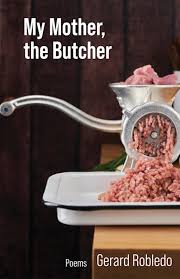
Gerard Robledo
Texas Review Press
2025
37 pgs.
$16.95
Book Review
“Your feet flat keeping time / against my belly pushing me up / until I open like an umbrella.” And so begins Gerard Robledo’s debut chapbook, My Mother, The Butcher, a work whose title and cover is brutally honest though exquisitely rendered, refreshingly vulnerable though incredibly powerful, and often tragic though also revelatory and transformational, even celebratory at times. With titles as intriguing and confessional as “A Sunday Without Eucharist,” “Text Message to an Ex-Girlfriend: Mother’s Day,” “The Last Days of Summer for an Alcoholic,” and “How to Raise a Poet,” Robledo, in only thirty-seven pages, recounts and critiques, reclaims and thrives.
Take, for example, “Off-Brand Man,” a fittingly titled free-verse poem in couplets that relates one of the speaker’s many painful memories of his mother, an arguably villainous character who, more often than not, judges and shames him for not fitting traditional notions of machismo, notions reinforced at the speaker’s expense and to which the mother too eagerly subscribes. Recounting his mother’s words (more accurately, a warning), the speaker says,
Veins / should be clear and bold as the printed daily special, / according to my mother, glaring at my arms / in high school—her voice oscillating between disgust / and disappointment with my paunchy extremities. / The veins lost in the 70/30 meat mix that I am— / discounted for quick sale, never on the top shelf, / maybe in an easily passed bin, or at least in a plastic bag. (Robledo 10)
There are a couple of things to note here: One, the use of the couplets is anything but arbitrary. Though not always addressed directly by the speaker, the mother plays an important (if mostly harmful) role in Robledo’s chapbook. The form of the poem not only reflects this strained relationship (such a classic two-line structure traditionally representing two people, or voices), but also reflects the oppositional situations in which the speaker consistently finds himself: Robledo vs. his mother, Robledo vs. machismo, Robledo vs. himself, etc. The use of commercial imagery (discounted meat, binned/bagged meat) also indicates a critique of capitalism, an arguably reinforcing source of gendered roles and expectations to which the speaker constantly compares himself and by which he judges himself. Even the title itself suggests as much.
Penultimately placed (and effectively so), “How to Raise a Poet,” another free-verse poem (though one notably distinct in its multi-page length and its list-poem-like nature), not only displays Robledo’s skill as a first-rate poet but his ability and comfort in breadth of form, too. As with “Off-Brand Man,” the speaker of “How to Raise a Poet” addresses, among other issues, maternal neglect and abuse, misogyny and sexism, and self-loathing. Unlike “Off-Brand Man,” however, “How to Raise a Poet” also confronts racial prejudice. In such lines as “Tell him he’s getting too dark in the summer” and “Let his sexist, racist bother mentor him because he’s the eldest,” the reader is not offered (maybe gifted?) a biographical sketch of Robledo but also a more empathetic understanding of the effects of such trauma, notably the author’s alcoholism and his long, arduous road to recovery (ibid. 32).
If what the epigraph to Robledo’s chapbook (“As children, we believe / our parents are gods”) says is true, then My Mother, The Butcher might be rightly considered be considered an exercise in debunking myths. More than that, though, it’s a testament to survival and resilience, a forging of something beautiful and true from scar and ashes. What is that if not worthy of a read or two? What is that if not sacred work?
Jonathan Fletcher holds a Master of Fine Arts in Creative Writing from Columbia University School of the Arts. His work has been featured in numerous literary journals and magazines, and he has won or placed in various literary contests. A Pushcart Prize, Best of the Net, and Best Microfiction nominee, he won Northwestern University Press’s Drinking Gourd Chapbook Poetry Prize contest in 2023, for which his debut chapbook, This is My Body, was published in 2025. Currently, he serves as a Zoeglossia Fellow and lives in San Antonio, Texas.

 VAGABOND CITY