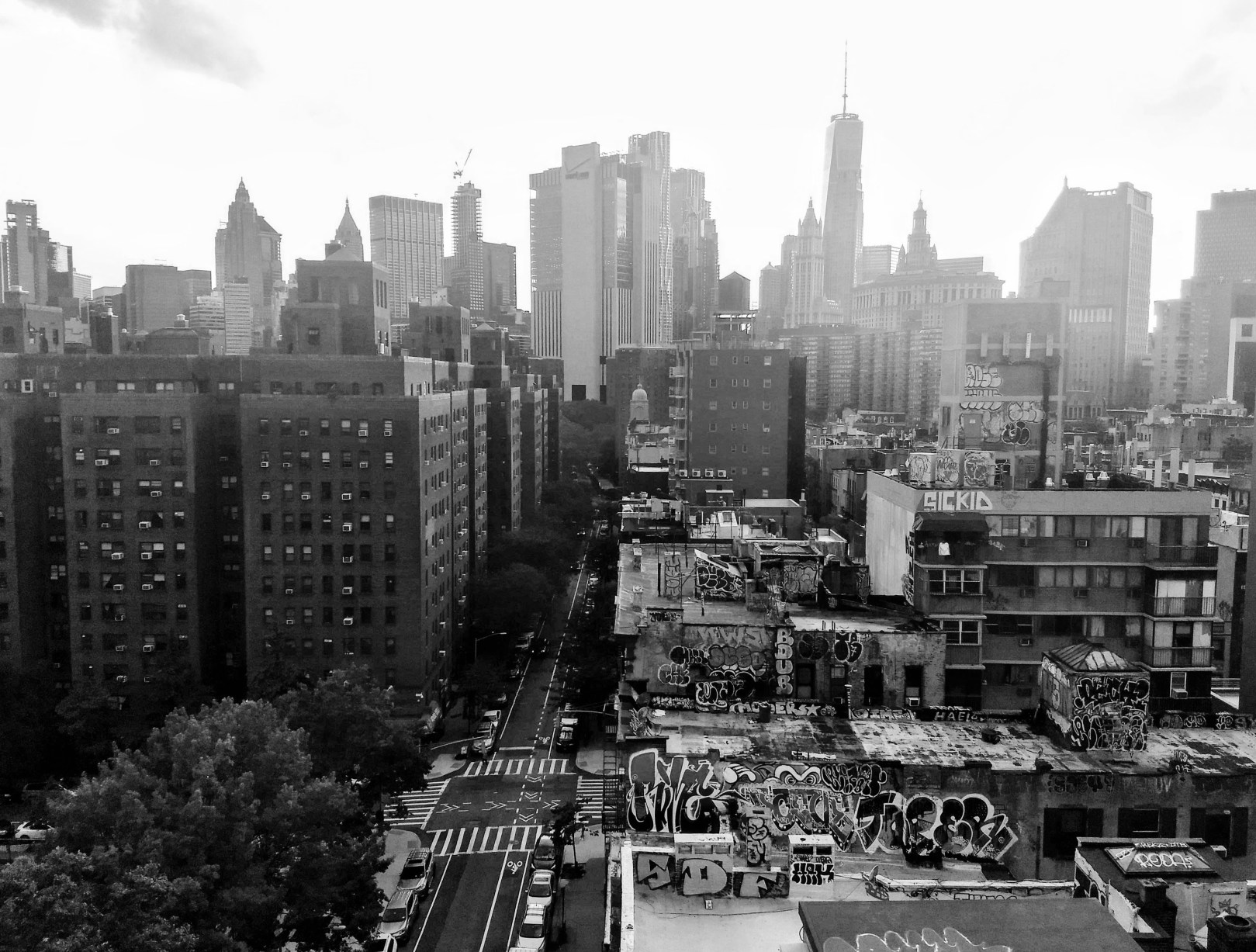
By mid-morning, the sun had straggled above the river, and Carmen was again staring at one of the rich boys from Palo Alto. It was the middle of a sweltering and unstoppable summer, the Fourth of July in waiting. The light laked its way across the sidewalk to where the two of us sat, under the clean row of white oaks, overlooking the water, our bare knees pressed to our chests. I could smell something burning on the grill.
Carmen is the definition of pale. The daughter of a high-end dermatologist, she pockets a stick of sunscreen, a film of white cream now smeared unevenly on her face, a dollop caught in her hair, making her appear almost ghostlike in the sullen heat. She has flown here from the suburban outskirts of Los Angeles and knows nothing other than California. On the day after I met her, she told me that her greatest fears were dying early from skin cancer and getting fat.
“Is that something to be concerned about?” I asked her as the bus we were riding turned into Concord Avenue, “I mean, does your family have a history of cancer?”
“No,” she said, smiling. “But my father just tells me about so many of his patients with melanomas—he said that one of the young girls he was treating knelt over one night and coughed herself to death—that it’s hard to forget.”
The street with red-brick buildings passes by, and it occurs to me how unaware she is of her loneliness, how she possibly senses its budding presence but chooses to look away. There is no other reason to be so forthright about dying. Outside, the Commonwealth Hotel passes, the Boston Public Library comes into view, pedestrians board the red line to Haymarket.
“Besides, the whole thing about body positivity, I don’t understand it,” she continues soberly, “Did you see that survey where most women said they’d rather get hit by a car than be considered overweight—you know, I think all the girls here, well definitely, at least the ones from Cali, would agree.”
She has a point, I tell her. There’s no use in pretending there’s progress when there clearly isn’t any. When we go out that night, I watch her order the most expensive fish tacos on the menu and leave a tip almost as much as the meal itself. In between bites of tender meat, she walks through the gestures of rolling up a joint with a dinner napkin, amused at my expression, and tells me about the prom party her friend’s parents hosted, brimming with liquor and teenagers in love. On our walk back to the dorms, she asks me how I feel about Matthew.
Now, next to the sidewalk, we are watching a group of dark-haired boys throw a frisbee, roughhouse, one of whom she is smitten with. Her jawbone tenses. Matthew is lean and delicately beautiful and doesn’t want her, even though if I had to, I would bet my life on the fact that Carmen could get into any Ivy League school of her choosing, so I suppose she has that as a form of consolation.
But watching the water, I am thinking: to get to all of this, the earlier days had to have passed by, ruefully awkward—though I can only recall scarce fragments of their existence. What I remember are the nights; the nights were the hardest to live through. Often, I would wake up in a painful sweat, perspiration streaking across my temples and seeping into the mattress, as if a giant teardrop had run its course through my face. Boston, hot like back in Texas. I had not known the heat until I stood in front of the bathroom mirror at night. I threw out one finished water bottle after the next, drinking until I could feel my head clear again. There was no air conditioning in the dorms, and afterwards, I spent nights with my face shoved in the minifridge, then through the open window, feeling for a rush of slightly warmer air. Outside, the city did not seem to stop: the headlights of cars, business trucks, and trains slurred into each other like strawberry slush, the sky-rise apartments and company buildings’ windows lit up in rhomboid blots.
I called my mother one night to tell her about my exquisite suffering. In the stairwell, which was even hotter than the dorm rooms, the line rang. The first thing I heard was her voice asking about the number of dining hall passes I had left unused in lieu of eating at restaurants.
I knew my mother was annoyed, but a few hours before, Carmen had bought and left an entire plate of lamb untouched, then wandered through Newbury Street, darkened by rain clouds, laughing with Angela and Victoria in the aisles of an Estée Lauder.
Well, this program was already ten thousand, and we don’t have that kind of money for you to be throwing it around, my mother said, or something like that.
In the swell of the heat, I felt my joints pressed down by fatigue. I had this sudden realization that there was actually very little that separated me from the other girls. They were kind in their own way, if you could stomach it, they bought each other tubes of Chanel lipstick, set each other up on double dates, and I knew with an undeniable certainty that if I had pulled my card out and purchased some upscale brand of mascara, told them I would go to the Keshi concert late in July as well, snuck back after curfew, trash-talked some of the other girls, they would come to see me as an extension of themselves, show me their sadnesses, their hollowed out bodies. I was also certain that if I wanted to, I could stomach all of it.
We were at the checkout line, and they were paying. Don’t you want something too?
I had the money for the mascara. I had the money for their lipstick, and if I wanted love, albeit briefly, I had the potential to win a bit of it. I had the money for the concert tickets, for boys, too. But I could not ED my way into UChicago like Victoria planned and be done with this oppressive pursuit for greatness, or live like Angela and have my parents phone the police station at 3 in the morning to bail me out of jail and wipe my record clean.
There was a moment then, when I felt like I had a fraction of something, though I cannot place what it was, and there was the moment after, when I lost it. There were so many things in the world, and none of them would belong to me now or later—so why bother? We were at the checkout line, and I could not bring myself to buy anything.
My mother tells me to take care of myself. I did not realize I was crying until the call had ended.
You have to know that I could not write what I wanted to say for the longest time. I start this months after I flew back from Boston, but truthfully, it began long, long before, at an unpinpointable time in my early childhood, so there is no use trying to recount what cannot be remembered.
In Texas, September is when the golden leaves are tousled into the air, when the days shorten and remain unformed, and we are all trying for some kind of happiness in the small hours. Linda is blatantly hinting that I give her part of my lunch, so I do. I listen as she goes through explaining who she has had the misfortune of running into today. It is part of girlhood to hate whomever your friends dislike: the ex who ghosts, the ex who gaslights, and now, the academic rival who makes false accusations and cheats.
“She’s an asshole,” Linda is saying about the girl who has made her way to a higher academic standing and outranked her. I am surprised it took her this long to realize what has been happening. She slams her notebook on the floor for emphasis. Linda is a good student, so good in fact, that every time grades are finalized, she passes her report card around to show us her GPA.
Jenny laughs at this and takes a few dumplings from me as well. Jenny can laugh because she has a boyfriend, something none of us can seem to obtain or keep. Jenny is special and condescending in her own way; she sees the way Linda hungers when people walk past her to ask Jenny to partner with them for English projects—though she’s a worse student—to represent them for the student prom, to take her out downtown. You know how I feel about Jenny, Linda has told me repeatedly. I am sorry for both of them: it takes a different pain to know hunger your entire life.
Similarly, we are all jealous of this cheating girl for reasons beyond morality. I know this is the type of secret we all play around and possibly try to repress, but are also angry at and angry at our repression, and we sink our teeth into that anger.
“You oughtn’t feel too bad,” Jenny pauses before Linda tells her to fuck off. She purposefully loses her thought and pats my head: “Anyway, these dumplings are delicious. Aren’t you so lucky to have your grandmother’s cooking?”
The unexplainable thing is that I knew I would be unhappy in Boston, but I left anyway. I chose this life, not because I knew I would love the city, but because it was of my own choosing to chase after this embodiment of change.
If anything, I liked the mornings more than the prestige of the summer camp. By 4 am, the skyline was a deep orange near the horizon, but lighter in shades higher in the sky, and by 5 a.m., the sunlight through the blinds was the color of early afternoon. I learned to live with solitude in a way that was akin to necessity, both despite and because I had begun to know many people. I call my mother daily: she tells me about a previous night’s dinner with family friends. I watch her on the phone: she dries her hair with a towel, wetness seeping into the cloth. I ask if she’s enjoyed her time. She tells me who has accomplished what, how proud their parents are, and I ask when she will be happy with me.
After that, I spent those mornings tossing aside the research papers I should have been poring over, listening to the slow draw of breath from my sleeping roommate, writing the first drafts of poems.
Linda tells me many things I do not know, and because she is so much better in all aspects and matters of life, she says all writers must be insane. We are playing mahjong at her house during a late-night hangout, waiting for the automatic table to wash the tiles, when she asks to read a poem of mine.
“It’s decent,” she says, looking up from my phone, “But all of this art makes you a less rational person, no? I could never do something like that to myself.”
The clink of the acrylic surfaces covers the small talk across the table.
“Don’t feel bad about losing,” Linda whispers to me with a slight tug in her voice when the game begins, though she is sober. I have to strain to hear her. “This game is too well thought out for you.”
I play the round. I leave early.
When I drove home during those earlier summer nights, those long-winded days of my life before I left for Boston, I looked at the wildflowers growing in the median strip on 620, and ardently wished I could be good at something. In the sudden gaps of time, each more like sluggish moments of respite, when I thought that I could be good at writing, I begged for anything else as a talent. I don’t believe that anyone can walk through and leave a life unharmed, but there were moments then when I thought I might collapse from the sheer exhaustion of desire. I was a young, scrappy girl again, skinning open presents under the Christmas tree, holding my breath in anticipation for the sensual figure of beauty, for the ease of brilliance, for the articulation in quick wit.
Pressing my fingers against the steering wheel, I sat under the dusky light, embarrassed by my lackluster existence. Please, I remember thinking, closing my eyes briefly at the red light, let me be great in a reasonable way. Let me have something worth having, worth envy. I have waited for so long, been such a good kid. What more do I have to do?
I have always had the most incredible luck in the most useless situations. I managed to get through most of high school despite learning very little about anything except for poetry. When I am leaving, Linda is upset because I have placed down a winning hand in a mere ten minutes.
Please, I think, as I am opening my car door, not like that.
The evening purpled and bruised and finally darkened. The street lights had turned on, but I didn’t know when this had happened. A few sparrows hopped along the pavement that was sheened with a layer of rain, as if about to flap their wetted wings. Inside the H-mart on Huntington Avenue, I understood I did not feel guilt-ridden about wasting my time wandering the streets into arcades, bubble tea shops, and restaurants because I felt then that I had all the hours to let my imagination run, all the late evenings in the world.
But I do remember Austin with an undisguised greed when I am away, thinking of my parents alone at the dinner table. It is a fresh summer, when grandmother’s garden is dusted with dew in the mornings and sprayed with the churning of golden light during sunset.
Every year during this time, my mother will get up to take a call. I imagine her asking one of her friends if they would like a batch of our garden chives. I know our family is always in the act of giving—but even now, I still wonder what we are trying to compensate for. The only thing I am glad of is that I do not have to witness this in person.
Outside where I am sitting, the smattering of rain continues. I am thinking about this blonde girl whom we almost left stranded in the middle of Government Center, in a foreign space miles and miles away from the university dorms, with no way back but only through the blue line, between loud art vendors, countless unnavigable buildings, and fast train stops. I cannot stop thinking about her. That night, we slipped through the zebra crossings, watched the traffic slow, took an Uber at 10, just an hour before curfew.
I wake in another sweat: Carmen and I are sitting by the river, soaking up the perfume of the lavender grasses, watching the birds take to their slow journey. The sky is a brilliant blue, and neither of us has noticed. Victoria and Angela have come by, and are all determined to see what the city has to offer: window shopping after a cruise on the Boston Harbour, dinner in Allston, then to the Esplanade on Storrow to watch the fireworks bloom and fall over the Charles River.
When the blonde girl joins our group, I ask her if she finds the food satisfactory.
She nods seriously and points across the river. “Do you see—that’s where I’ll be going to next year.”
Though none of us know each other more than simply in passing, we know she is odd, and not just in any colloquial sense of the word, because across the river is Harvard, and Carmen’s looking at her strangely because this girl’s SAT score is not even high, her accolades (the story she repeats about her job as a waterkeeper, pulling out a loaded pistol in the middle of a river) are nothing to brag about in this circle of people, and how could she possibly think so highly of herself and verbalize it with clarity.
The wind passes roughly through our hair when we are leaving the pier in the harbour. Carmen has spent the entire trip holed up in the restroom and now says she cannot come with us when the girl approaches again. Angela knows this is her cue to leave as well.
And so we are in the city, Victoria and I, the girl trailing behind. From afar, Victoria says you could mistake us as her older sisters, though we are the same age, because she is much shorter and distracted by the colorful mural paintings, the tall worship cathedrals, the concrete pillars. As we turn past the corner to the aquarium, I find I am exerting more and more effort to keep up with Victoria’s walking pace, which has grown brisk and borders on running.
Victoria begins to speak in Mandarin. “Let’s go,” she says, pulling my wrist, “quickly.”
I know what she is doing as she is doing it—I look back, and now we are mostly out of the girl’s line of sight, tucked between groups of strangers who are testing the fabric of hand-sewn scarves between their fingers at a fashion booth. We can’t do that, I tell Victoria, she’s not going to know the way back.
Victoria says that rooming with her is hell and gods, why would I care, it’s not like she’ll die from loneliness.
I am awake and mulling it over, again and again. All this unwavering freedom, and it goes nowhere, brings us unbelievable sorrow. I must have understood in a sense that at that intersection, as the cars and people sighed on their way back from living, I too was not only lonely in a big city, but truly alone, by which I mean that if I had done anything terrible or had something terrible done to me, very little of it would come to matter. Though there were times I became someone else, I was still a child in many unconquerable ways.
I am sweating and cannot bring myself to stop. I watch as the city fevers in response. I wonder if the girl we were about to leave has ever had to live up to anything, beaten herself up from failure, had to fix her damage, had to learn humility from humiliation. If her parents can look at her properly at dinner and tell her that she is whole in some sense, unbitten by mundanity. If she will die having been understood by someone, or not fearing not being understood. Does she struggle to want because she does not know the depravity of having to look at yourself in the mirror after mornings spent in the act of dissecting one’s worst intentions? Is the issue with poetry, or with me? What is it like to look at things and assume—possibly even know—that they are yours to have? And if they aren’t yours, does having the bravery to believe that they are, even for a brief time, mean that they do, in some sense, still belong to you? It is imprudent to assume that others do not hurt in similar ways, that you are the only person who thinks deeply enough to be living in a state of excruciating sensitivity, but if she were truly oblivious to the mockery from strangers and friends alike, I wanted nothing more than to be like her.
And of course, there was the girl back home who was hated for very different reasons, who copied answers and bought tests from the internet—because of her proclivity for insult and accusation, her preoccupation with herself, her willingness toward condescension. Some things occur to me only at night: if she had been reported for these activities, I know it would have killed her, because I, too, wanted so desperately to be good that if I thought about it for long enough, the throbbing inside my heart would branch its way into my joints. I wanted to pierce this girl and watch her real self overflow, show that my understanding of her was not wrong—her desire to protect herself from the clear, sharp pain of not getting what you want, and worse, losing what you already have. How difficult it is for any and all of us to admit that we are not who we are asked to be.
I think about what has transpired, about what I have deserved, the whole of everything I have been given, the whole of everything I have been denied. We accept things to live, or we do not live, but I want to leap into the silence, any silence that can hold me, throttle it till it whimpers and seizes, beg everything to be mine. Ask if there is a reason for my plainness, my mediocrity. Ask how much of my writing is failure going nowhere. Ask where is the additional point on my test, where is the audacity I have lost. Ask which limb is wrong with me—where is the problem, the foregone brilliance?—so I can cut it off. Let me be lonely but not forgotten, I tell myself, sometimes even beg myself.
I was born in this body of mine that my mother calls average. Sometimes in my dreams, she is calling me again, sighing and saying: There are stones used to repair the sky, and there are stones that live by the wayside. The only difference is the view—but it does not mean that when you write about yours, it will be any less beautiful.
When Carmen tells me one day she wants nothing more than to have something other than money, she reminds me of Linda in an uncanny way. We are on our way to the laboratory, passing Arlington, the bridge with the love locks, the leaves and flowers by the sidewalk in full bloom.
It is the middle of July when she says that she’s learned that you can’t write about wanting to die in the Common App. In the same breath, Carmen continues: she’s skinny and rich and model pretty and so, so smart, and she doesn’t understand why Matthew doesn’t want her, and I think she’s the one who’s been crying softly in the restrooms at night.
I tell her that I would do anything to be like her, and I am surprised at how easily I can believe it.
At least you can write. I wish I had that. Carmen says quietly to me. Those college essays must be easy for you. It is at least better than nothing.
There is a beat of gravid silence. “If you want so badly to die, then why don’t you?” Victoria asks.
There was a night when my mother drove me home from a late-night orchestra concert, and I was sure that I was sad enough that only Boston could understand me. I put up my violin, walked into my study room, and saw my grandmother had left slices of apples and milk on my desk. I love you, I told her.
I remembered when, on one of the afternoons we spent wandering the school during finals week, Linda told me that she liked talking to me because I am a fundamentally unhappy person. Let’s suppose I won every contest, had every great thing, had the money and the genius for all the universities; I would be exploiting myself to prove her statement true. The mornings would strike me as beautiful and worth living for, yet even if I had everything, one day I would still wander home inexplicably saddened again, and the cycle would continue relentlessly.
Every book I have read has told me the same thing: you could be in love, be close friends with someone, love them like family, share half of your life with them, and yet nobody will ever come to completely understand any of it.
I open so many of these college applications, and they all ask what does writing mean to you, what does writing do for you, what is writing, do you love it, does it make you happy, are you proud of yourself for writing, why do you do it, why why why?
It is at least better than nothing, Carmen says, and I repeat this to myself until I am my mother, until I am about to throw up writing answers to these questions. When she said that, I didn’t know whether or not I was supposed to sit down and begin sobbing.
Sometimes when I dream, Carmen wishes she had my sadness, my shoddy ability to write. Her long, pale fingers are pulling at my clothes, the skin off my face. I want to throw something at her. No, I say, it is not yours. Nothing else belongs to me, let me have what little I have, I tell myself when she buys the entire Estée Lauder store, when I drag Victoria back to find the girl unhurt by our fleeting disappearance, when Jenny is named prom queen, when Linda has struggled meaningfully and gotten into the college of her dreams. Forgive my intended and unintended cruelty, my body that is none the wiser, the long years when I disgraced my family, offered so little to anyone because I had no knowledge, when I had to think and think hard before choosing goodness.
I remember telling my English teacher that if I knelt over and dropped dead, I think I would be the saddest about not having written what has to be said. That’s important, he said, but I still don’t know why. There was a time when my parents thought I might be anorexic, but I had been spending time watching my family at the dinner table and had forgotten to eat. I don’t know why I don’t value my life as much as I should, but there are some things so important that I know I must be alive for them to matter. I looked at everyone everywhere and wondered where they came from, and what ailed them, and who they were sorry for. I knew that my life in Boston could never be replicated back home, and that very little of what I saw or felt or heard could be properly explained to my friends. Watching each fresh person pass by on the Esplanade at night, I saw the impossibility of opportunity to know them, and I had this sudden feeling that I would never be so happy again. I realized then that I loved it, that I loved writing in the only way I knew how to love something: oddly, freakishly, longingly, perhaps awfully so. I wanted badly to say that writing was not something to be used as a heartless tool, to be momentarily offered as a sacrifice in the fight for self-worth, and what Linda meant by “fundamentally unhappy” was the time I spent and the ability I had gained to pick other people’s sadnesses like locks, crack open their grief to store as my own. When I am crying as I leave her house, I am crying because I know she is right. Even I, who has spent so long repressing my wants and sometimes even my needs, know that I only exist in completeness, but also strangeness, when things are made even through language. It is mine, mine because I have wanted and waited for it, like the good kid I am. Take your money, take your Princeton acceptance. I wanted to be good then, as I do now.
Everything I had sensed told me good writing came from somewhere so deep that if I dug a well through my bones, I wouldn’t be able to touch the marrow. So often, and every day, I am sure I will never get it, but I keep trying stupidly, I keep trying.
One evening, my mother called to see if writing was turning me soft; she worried I would give up my life too easily for softness growing inside me.
Is that a bad thing? I asked her. Of course it was. I had not lived long enough to do anything good with my life yet.
Some people are just good people, and you can just feel it. My mother was good and right about my life. I sat down on the expanse of grass before the dorm building, having left the dining hall, peeled my heart open out on the edge of the track field, counted the years of dulling veins. I wondered if my gentleness now was in repentance for my harshness during my earlier years. Out of all the things in life, I realized then that it was hardest to disappear without anyone noticing. There were things I hadn’t wanted in this life, but the birds are flocking home—oh, you miraculous thing. I wanted to pull them out of the sky because I had been so lonely. How often I have failed to look when looking would have changed me. I wanted someone to tell that all of this had hurt me too, immensely so. I sat there, and I sank my fingers into the dying matter of a volta.
The reddening laughter of children racing by on skateboards. The sky wanted to say something, but it couldn’t; the blunt light trying its hand at sunset. The urge to write something damningly beautiful had never been stronger. In the tawny July air, I had a distinct, radical feeling that everything could be momentarily summed up with a closing verse.
Michelle Li has been nationally recognized by Scholastic Art and Writing, Bennington Young Writers Awards, and Apprentice Writer. An alumna of the Kenyon Review Young Writers Workshop, her work is published in Aster Lit, wildscape. literary, and Third Wednesday. You can find her at michelleli.carrd.co.

 VAGABOND CITY