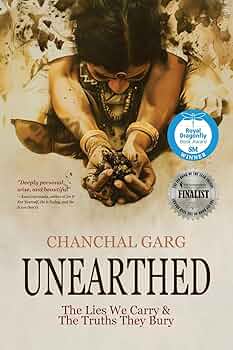
In Chanchal Garg’s memoir, Unearthed: The Lies We Carry and The Truths They Bury, she reminds us that the power to choose one’s own destiny is most impactfully taught to others when we do it ourselves. In a story about seeking individuality between two cultures and apart from dogmatic faith, readers can find wisdom in Garg’s decades of steady self actualization. The literary market’s faith deconstruction narratives are primarily written by and for white Christian women, making Garg’s story of deconstructing Hinduism as a South Asian woman a welcomed emerging dimension.
Garg begins narrating her story from her adolescent years, where she alternates between scenes of studying the Ramayana together with her family and landing musical theater roles at her high school. Her passion for both her culture and the performing arts are close parallels—she describes singing the Ramayana verses as “a space where [her] emotions could flow freely” (14) and each rehearsal of the high drama club and show choir as providing “a sense of belonging that anchored [her]” (30). Yet instead of being complimentary to one another, Garg describes a sense of competition between the two ways that she felt most herself. As a young South Asian woman growing up in the United States, she describes this clash of different cultures as a turmoil within her own individual identity.
Looking for a sanctuary amidst such an adolescence, Garg found herself seeking solace in the faith she was raised with, Hinduism. While Hinduism reliably nurtured her sense of spirituality through music and epic narratives, the teachings her parents emphasized were not just a faith in a higher power, but a faith in patriarchy itself. It became a given to Garg that the role of women was to submit to their fathers and husbands. “I was grateful,” Garg describes her youthful optimism, “….for the Ramayana, for my culture, and for the goddess to whom I could pray for a good husband” (4). Alongside these prayers for a husband, Garg also vowed to avoid even the slightest semblance of betraying the husband she hadn’t even met yet. “I wasn’t just determined to protect my purity,” she describes in her first chapter, “I was determined to avoid any situation that might invite doubt” (5).
It’s a classic description of purity culture, one that many of us are used to hearing in the context of Christianity. Faith deconstruction has become more popular than ever in recent years as a discourse, practice, and narrative entertainment for curious onlookers. Documentaries like Amazon Prime’s Shiny Happy People, popular TikTok accounts and YouTube channels of ex-mormons, and even Ethel Cain’s wildly popular album, Preacher’s Daughter, contest the warped lessons of fundamentalist religions with intricacy and thoughtfulness. The trouble is that this class of media revolves around Christianity, leaving little room for other religions to unravel parallel experiences. Furthermore, while women and queer people tend to be the ones defecting from Christianity once they learn the limits of how much their supposedly loving religion cares about them, these former members are overwhelmingly white, which also limits the reach of extant purity culture discourse. Garg’s memoir is important because it’s breaking new ground here in deconstructing non-Western religious trauma, and adding perspective of a woman of color to the question of patriarchy within religion. At least for readers within the United States, this is a relatively new story on our shelves, despite being one with a long history.
Luckily, Garg has written Unearthed to bring this underplatformed perspective forward. As the narrative continues, Garg recounts the period of her life at the end of high school, wherein she quickly became attached to a Guru her father introduced her to. This character, Babaji, is introduced with an air of mystery—he promises wisdom to Garg, but as soon as he emerges on the page, we see her world narrow rather than deepen. Within just a few pages, we watch Garg become engaged to another one of Babaji’s followers, and be raped by Babaji on the night before her wedding. Corrupt male leaders and sexual abuse are out of the familiar, cross-cultural playbook of patriarchy, but Garg’s story turns new pages as she questions the specific role she’s been conditioned to accept from the different intersections of her identity. As terrifying as this chapter is, readers recall the previous details about our narrator—our first impression of Garg, after all, was as a plucky middle schooler who did her makeup in the school bathroom to defy her father’s strict rules and who ached to play Anita in West Side Story because of the character’s strength. Knowing the seeds of independence are within our narrator, readers wait for them to germinate. We root for her way out of the trap of purity culture, dogmatic faith, and ill-intentioned men with confidence—because we know she can escape.
What makes Garg’s memoir so impactful is that her escape doesn’t come in one grand moment. Instead, she finds her way out one step at a time. Sometimes the choices are big—like leaving a marriage, and leaving the religious group that she’s come to see as a cult. Other choices are smaller and more mundane—like maintaining a weekly Zoom group with other South Asian women—but arguably just as important in the chain of consistency that selfhood requires. The slow burn of selfhood also successfully breaks the binds of Garg’s youth—choosing between being the Indian girl” and “the American girl” shifts from an urgent crisis of adolescence to a false dichotomy that slips away once Garg starts to choose herself. Memoirs are nearly always powerful in their unwavering realism—this is, of course, the point of the genre. But Garg’s story is particularly constant in reminding us of the eternal task of choosing yourself, bit by bit, in a lifetime project of becoming who you really are. Any reader, regardless of culture, gender, or religion, could use such a lesson.
Kelsey Ferrell is a writer, musician, and filmmaker. She holds an MFA in creative nonfiction from UC Riverside and a BA from UC Berkeley. Her writing has been featured in The Good Life Review and Amazon Prime’s We Were Liars.

 VAGABOND CITY