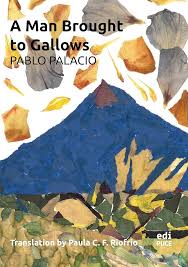
Indeed “the problem of art is a problem of translations,” says Pablo Palacio in his book A Man Brought to Gallows, translated to English by Paula Riofrío (p. 30). Interpretations are what form the imagination in this first edition short story that traipses surreal metaphors to bold depictions of our fractured society.
Andrés, the narrator, floats forsakenly between his desire to be part of the cube of man’s supposed existence and his desire to be rid of its borders. But his fear, along with his endless search for a place within Ana’s soul, terrorizes his sense of self. “Only here, inside these four walls,” he says, “it is you Ana and I Andrés: out there we were worms” (p. 33). Riofrío’s translation moves in seamless pieces, capturing both the poetry of the moment and Andrés’ absurd reality.
Read like the remnants of a Samuel Beckett play and the clippings of a Kurt Vonnegut novel, some lines are as simple as stage directions while others land atop metaphysical pyramids that take considerable time to ponder before turning the page. As Andrés attempts to explain the Earth, he becomes passionate about the idea of absence: “You cannot understand what nothing is! There is no one who can understand it. Neither there’s a need for it” (p. 45). It’s as if—within the disintegration of Andrés and the fragmented language that frames him—it is revealed how we are all looking for someone who simultaneously is looking for us. Residual absences in search of one another…
As life remains a constant act of asking who to believe, what to believe, the world of Andrés slips in and out of incongruous fables that are “fraying the thread of the story” but actually capturing the many unencumbered corners of his mind (p. 10). And in the fraying threads are some of the most remarkable gems that often go unseen in the course of linear storytelling. Riofrío gathers the at times sporadic text into digestible sequences that preserve the illusory nature of Palacio’s work, keeping the questions brimming along with frequent instances of bewilderment.
The text assembles a phantasmagoric collage—The Forest Rebellion, Love: Universe, Final Trip—that depicts a highly sensory world under fire. “The ear, sensitive as a metal sheet…the eye, nimble as lightning…the touch, fine as a flight path”—language that zooms in on the brilliance of the body as it traverses towards the other side of life, love, and death (p. 38). Andrés free—flows through these states, with sudden bursts of clarity on his purpose in it all—“Oh, rapture, now I know what hope is!”—only to be interrupted by the limitless metaphors of his own dimension (p. 47).
The ending of the story, rather, ends with a beginning, instructing the reader to re-read the same pages, humoring them that this was in fact a hallucination. Myself, having read the story twice, still find that I’m stuck in the middle with no hope for reaching the end. And so it goes…
Maxine Flasher-Düzgüneş is a Turkish-American multimedia poet and dance artist. She is the First Place recipient of the Rubin Prize for Poetry from NYU and the author of heart-shaped box, a poetry chapbook from Ghost City Press (2022) and through Eileeen, a young-adult novella from VerbalEyze Press (2020). Her poems have been recently published in Timber Journal, Ink Sweat & Tears, TriQuarterly, October Hill Magazine, and Stance on Dance. She is currently a writer for global dance publication, Dance Art Journal.

 VAGABOND CITY