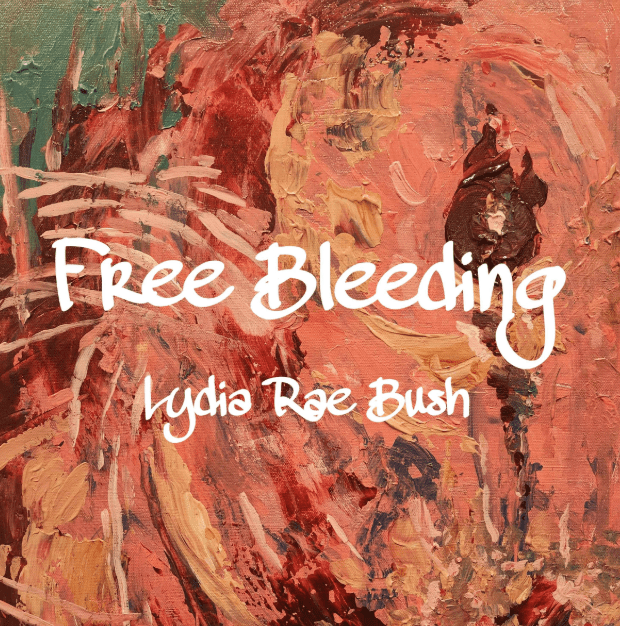
In the final stanzas of “Sanity,” poet Lydia Rae Bush defines her body’s position on the margins via contrast with “the center, / where I cannot stay or even land.” Unlike the poem’s second-person foil, whose position is described as “effortless,” the speaker “create[s] a constellation / with my jagged ebb and flow, // orbiting the heart of the graph.” In the context of Free Bleeding (dogleech books: 2025), Bush’s debut chapbook, “flow” is more than just a metaphor; the entire text was composed in the duration of a single menstrual flow. The dedication page offers this declaration of the book’s unique process:
I committed to finishing composing the manuscript before I finished bleeding in honor of the motivating power of hormones, the reconciliatory value of emotions, the inherent worth of human beings in all of their phases, and the intrinsic dignity of womankind.
This is a distinctly personal book; Bush neither claims to speak for all women, nor attempts any normative definition of womanhood. Instead, she offers readers an autofictional glimpse inside her own affirmative vision, based on the lived experiences of one body. The completed work deploys sparse lyric and abstract confessional modes as instruments of critical self-awareness, reflecting and contextualizing womanhood as something forged in the conflict between bodies and society.
Bush’s composition includes bodily analogy at the structural level: the book’s 30 lineated poems are collected into four sections, named after the four phases of the typical menstrual cycle. First is Follicular, containing seven poems that offer exposition of the speaker’s inner life and social context. The next section, Ovulation, features eight poems that sense and name conflicts between the body and its world. Third is Luteal, a group of eight poems that herald acceptance, emergence, and community. Finally, in Menstrual, the speaker returns to the facts of the body, this time encoding experience with the reframed and affirmed sense of self developed in the text. Although multiple second-person interlocutors make supporting appearances, the consistently strong first-person persona—inseparable from the compositional process—is the by-design source of momentum and authority.
The initial poems of Follicular illuminate the limits of the body, both biological and social. Sensation and affect are sometimes mapped in the abstract, as in “Digest,” when the speaker identifies rage by its location in the heart: “I find my rage // in the full swells unable to burst / from my chest, in the raised heart rates // that won’t fall back down.” External antagonists and their attempts to limit womanhood are also addressed, as in “Missionary Position,” a series of tercets addressed to a religious authority figure at the center of privilege:
I know it’s your job
to serve others,
love god.
I just think
that that’s what means
that you should stop
harassing me
with remarks on my body,
weight, and eating.
The “Position” of the poem’s title, a double entendre which cleverly extends the metaphor of center and periphery, implicates the biased graphs used by patriarchy to evaluate women’s bodies. Separately, the speaker of “Highs When Lows” directly recognizes the inherent conflict in subjective measurement, in a moment of emotional reaction, “when I am so tired // of oppression that my mania / starts to sound drunken.” This chapbook does not attempt to elucidate any comprehensive lens on the many intersections of mania and oppression (a topic for entire dissertations, to be sure); instead, Bush selects and presents just the relevant details from her own experience.
While retaining the foundational first-person singular perspective, a majority of the poems in the Ovulation section also deploy “we,” using first-person plural as a device for recognizing oppression as systemic. “Chokehold,” a short set of couplets, intentionally speaks for “we the marginalized,” defined as those who must “maneuver through and manipulate / their oppressive systems to get what we need.” Later, in “Happy People,” the speaker intensifies the verbs to imply that happiness springs from intentional action—when “we fight and we claw / with our teeth and our nails,” in order to “break / every curse, every chain.” These short excursions into polyvocality remain anchored by personal reflection, as in “Accountability Road,” which observes that rage against “games stacked by their makers” may still become turned inward:
Me and my lonely heart,
enraged by misunderstandings,
chip away at our own opacity,
occasionally
striking our sanity . . .
The phrase “striking our sanity” offers a satisfying double reading: struck as in accidentally damaged; struck as in found buried treasure. Instead of elaborating, Bush follows her tendency to let the straightforward word choice hang and resonate. This invites readers to embellish the narrative with their own striking memories, both of self-harm and of self-discovery.
The next section, Luteal, details how discovery of self and discovery of community are intimately related. A sharp contrast is drawn between those who intentionally antagonize or misunderstand womanhood and those who seek to recognize and accommodate its truths. Conflict between the two is exemplified in “Sweet Girl, Fun Guy, Attitude Projectors,” when the speaker warns,
your fondness, affection,
and your desire for connection with him
always drive you like a freight train
head-long into the crash
that is his disbelief in your humanity.
Rather than shrink one’s embodied identity to accommodate others who would deny it personhood, a pair of aptly titled poems offer readers an alternative: the promise of an understanding and supportive community. In “League,” the speaker asserts that “us filling up our space is not / the problem,” as those who project their own insecurities outward would claim; rather, the affordances of our idiosyncrasies are “the gift” inscribed in each body. Similarly, in “The Club,” the speaker offers an extended affirmation that,
your light deserves to be absorbed,
your shine can be reflected, your sparkle
known, your glitter studied and loved
in a world where some just opt
to notice—
For some participants of the “manosphere” discourse of 2025, even noticing would be a step up from denigrating. This does not dissuade the speaker from maintaining higher standards, reflecting a world where women’s safety is too often imperiled by men whose first conversational steps are disrespect and denial.
The book’s final section, Menstrual, uses language to enact, affirm, and record an embodied authenticity that reflects how it feels to be in true community. In “Hitting Your Mark,” the speaker explicitly contrasts the dictates of patriarchy and capital (“They say to flirt, charm, host, or / sell, sell, sell”) with the opportunities of authentic embodiment (“but I’ve got two hands, two eyes, a mouth, and a / heart, a heart”), eventually leading readers to the body as a site of acceptance and personhood (“when I got known, and I got accepted, / and my guest got a person”). There is also the incantation-like “Grace,” a list poem comprising more than a dozen affirmational adjectives, which calls the reader to exist with confidence, as “an accurate judge” of positionality, “free from guilt and shame.” The book’s final poem, “Foam,” reclaims subjectivity with the assertion that “I too have an opinion,” before ending with an imperative: “Take the treasures // and rest, / for the waters / wash themselves / out to sea.”
The unadorned style, unapologetic lyric speaker, and empathetic spirit of Free Bleeding situate it within the (North) American tradition defined by voices such as Lucille Clifton and Sylvia Plath, among others. There are clear parallels to Clifton’s voice in particular, in work such as “poem in praise of menstruation,” which contains a closing affirmation in a voice that is close kin to Bush’s speaker (“pray that it flows also / through animals / beautiful and faithful and ancient / and female and brave”), or “a dream of foxes,” which ends with an emotionally imbued image in seamless conversation with Free Bleeding (“honest women stepping / without fear or guilt or shame / safe through the generous fields”). Readers interested in the poetics of embodiment are encouraged to review not only Bush’s website and blog, Alphabet Ravine, but also the other titles available through dogleech books, a new independent press based in Canada, that hopes to spotlight “books that sing of queerness with a gothic lens.”
D.W. Baker (he/him) is a poet and editor from St. Petersburg, Florida, USA. His book reviews appear with Variant Lit, Paraselene, and Philly Poetry Chapbook Review, among others, while his poems have been nominated for Best of the Net. See more of his work at www.dwbakerpoetry.com

 VAGABOND CITY