
“In your memory of this moment, are you alone?” Lindsey Wagner’s collages offer glimpses into intimate fragments of the past. Each scene is accompanied by poetry exploring the nostalgia of unresolved moments and the contemplative longing for what might have been. This month, Wagner shares her influences and the detailed process behind her creative outlet.
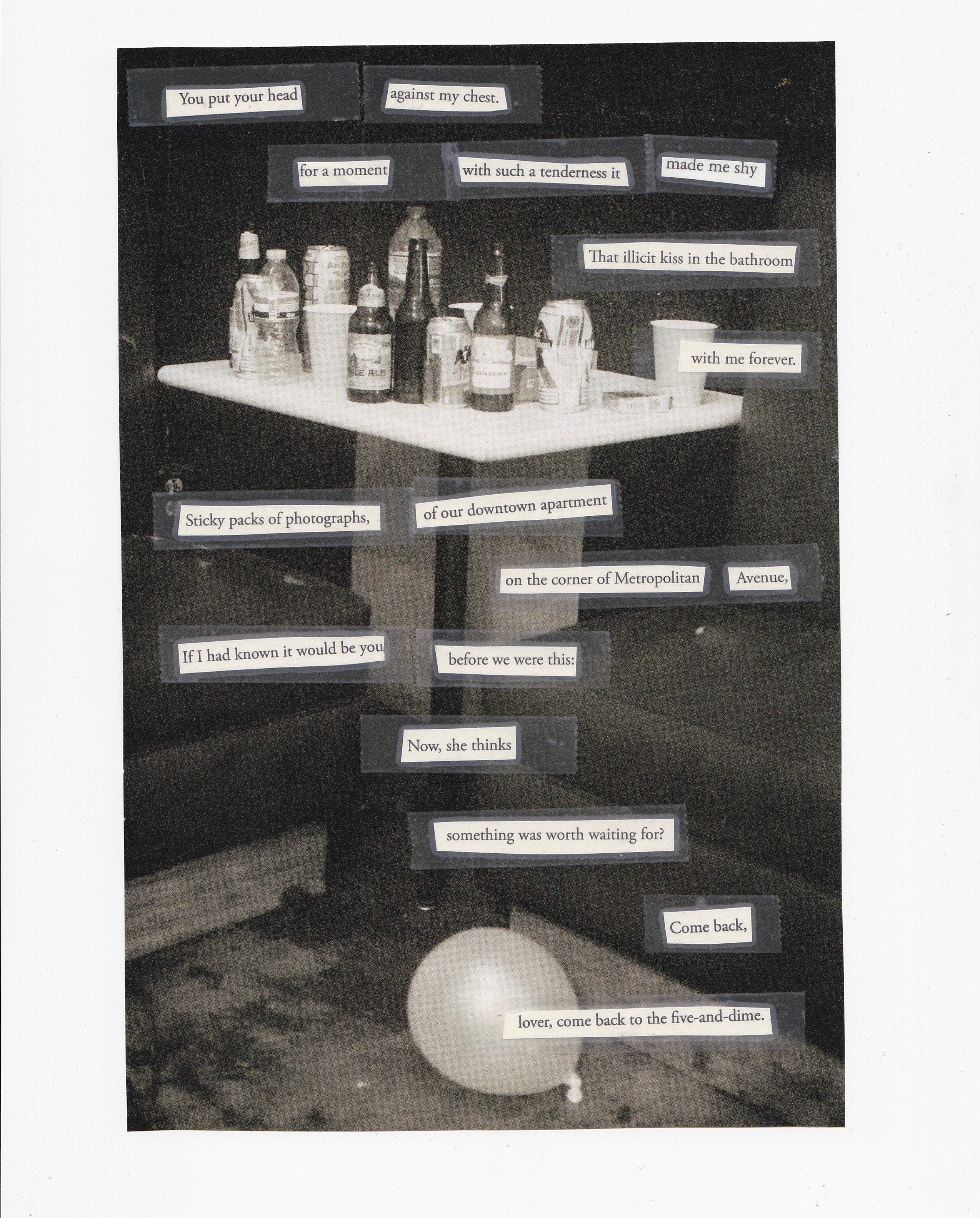
How did you get your start as an artist? What drew you to collage-making?
My family experienced financial insecurity when I was a pre-teen growing up in the cultural milieu of the New Jersey suburbs during the 2008 recession. With strict parents and a tendency for introversion, I spent a lot of time in my room. As a result, it became quite easy to immerse myself in the aspirational fantasies of my mom’s lifestyle and teen magazine subscriptions. I would sift through those magazines, tearing out images, articles, recipes, and workout guides. I organized everything into binders using a pair of my dad’s orange scissors (the same pair I still use) and a hole punch. Slowly the collection moved from binders to my bedroom walls. When you looked at the wall by my late teens, a subtle gradient of color, texture, and mood transversed across the 8×12-only non-vaulted wall of my room. I experimented with how different people, types of paper, textures, and different moods would layer together, in an exacting way, foreshadowing a brief career in editorial and creative strategy. Even then, I could discern but not articulate the chasm between the financial hardship I was experiencing and how I could cherry-pick specific elements to construct these escapes—like a game of artistic MASH—that represented alternative realities.
It is hard to demarcate my shift to an artist who produces work in a public-facing way from that of the creative ethos of my upbringing. Which is to say there has been this constancy of art in my life in some form as an outlet, an extracurricular, some basic academic training, and even part-time jobs. Without a clear separation between each, I never felt I had the legitimacy of a capital ‘A’ artist. I’m going to sidestep the conversation of what makes an artist legitimate because I think the feeling of outsiderness, or the tendency to observe from the periphery is evident in much of my work. When that feeling would appear beyond just my work and I would become intimidated, there were these incidences—winning local art contests, being asked to do work for a book, etc.—that would remind me of the levity and affirmation of creating beyond traditional lines of legitimacy.
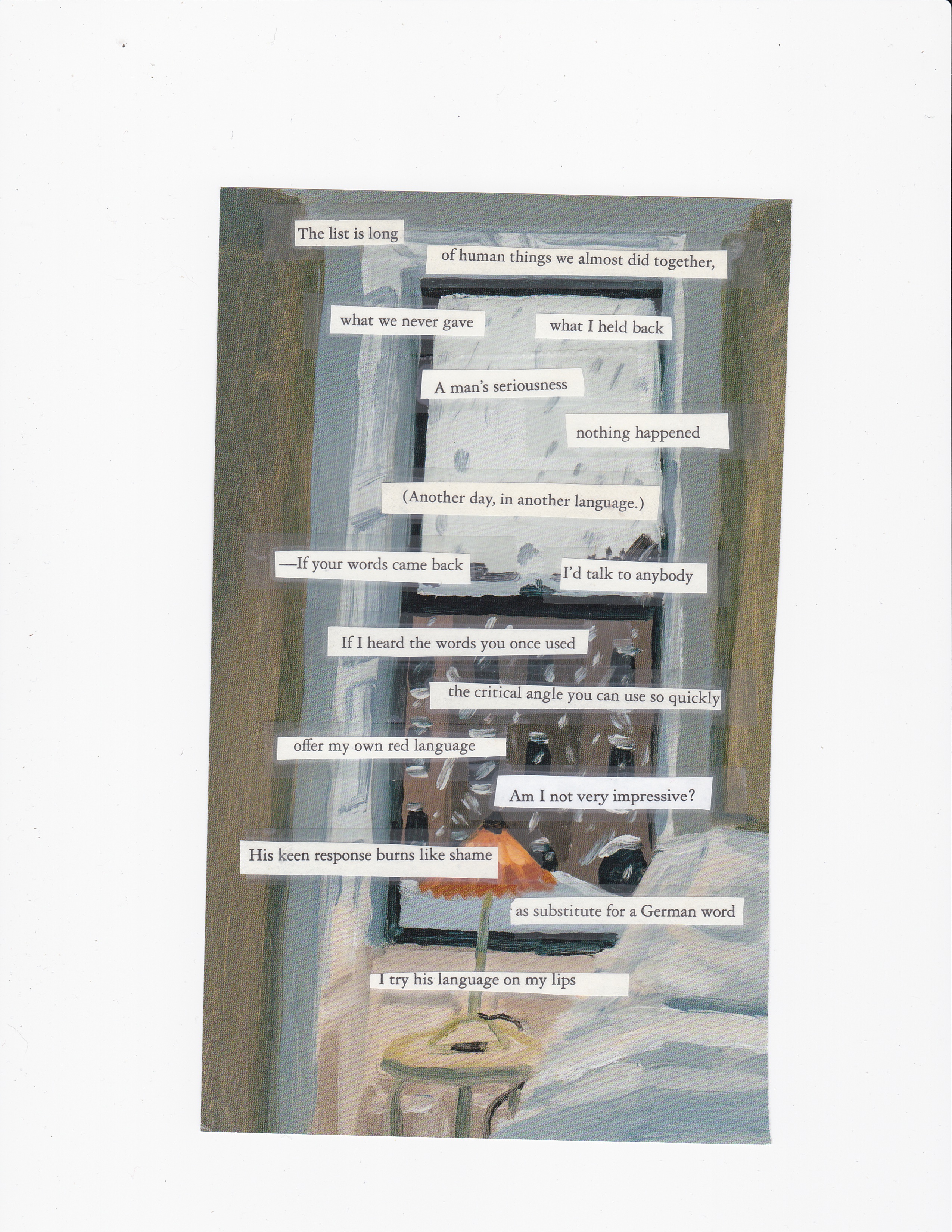
What inspired this collection of work?
I completed these poems towards the end of what would mark four years of major transition in my life. During it, I felt this interia and looming unknown that left me feeling rightfully untethered. Earlier this summer, I began experimenting with the inlay of poems instead of visual elements as the main feature of my collage work, and my circumstance of uncertainty naturally carried through into the voice and subject of the poetry too. Our lives are punctuated by these milestones—births, graduations, relationships beginning or ending, deaths— all have been extensively chronicled, scripted, and even anticipated. But I’m most drawn to the moments that make up the interstitial space of our lives, those that are part of our mundane interactions, and the awkwardness and intimacies that manifest from them. Often, these experiences become important to us in retrospect and become the fulcrum in our memory of a person, a place, or a relationship. Much of my resulting work has focused on instances of irresolution, feelings of nostalgia and grief, but also desire and yearning, located in these moments. Ruminating on all of the interpretations and potential permutations to provide some resolution, even if just fantasy (though my therapist would likely disagree).
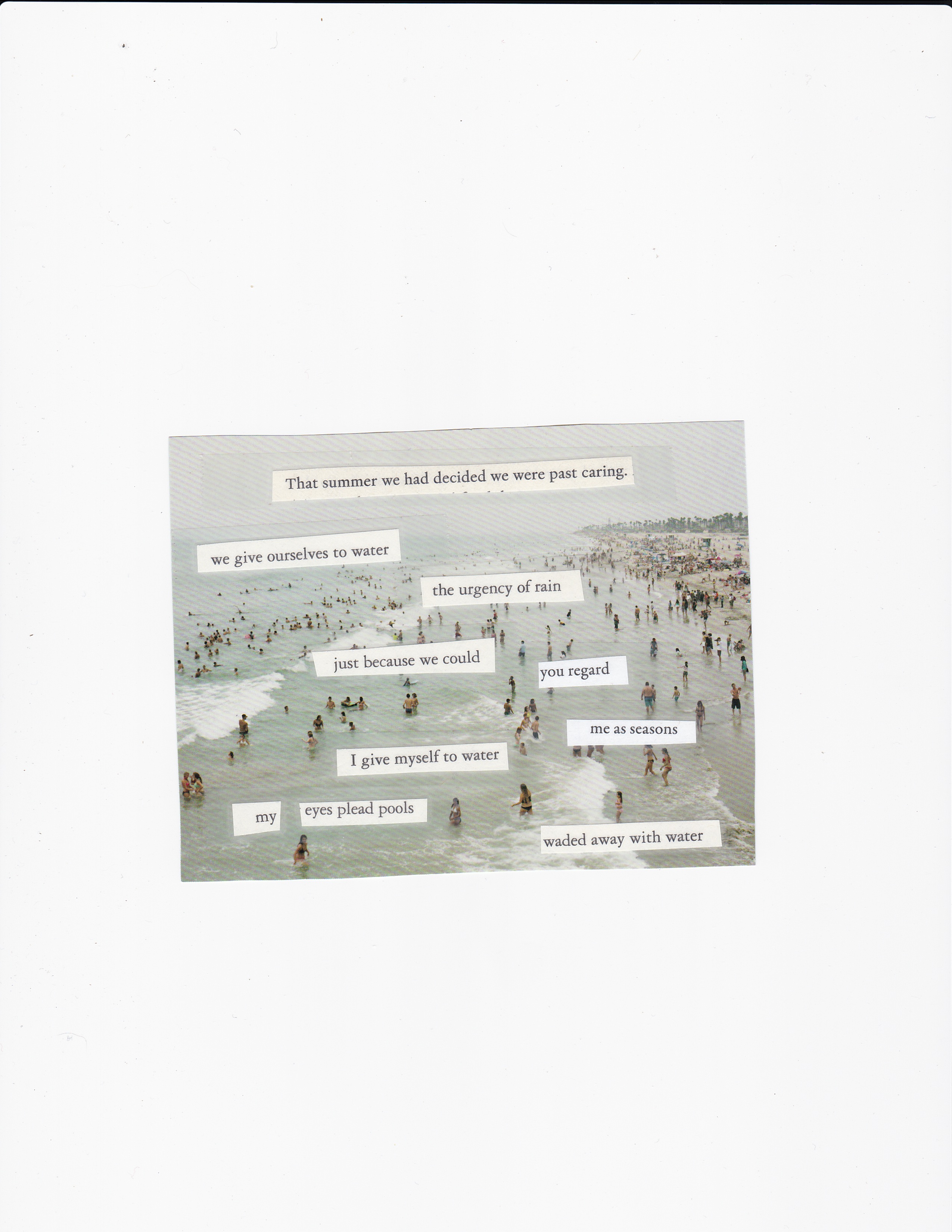
Your collages combine text and imagery. How do you decide which visual elements to pair with your poems?
I set aside backgrounds before drafting poems from a range of books, magazines, maps, literary journals, etc. that strike me when I’m pulling collage materials. I tend to be drawn toward serif fonts, low-gloss papers, and textures but not busy patterns or overly editorialized fashion layouts. I am now experimenting with other types of backgrounds like guest checks and ticket stubs instead of photos or paintings. It creates more cohesion between the text and images than when I first started taping the poems onto impressionist paintings I took from old art books. I consider the image as the setting and as influential to the tone and context of the poem as the actual words. You can see this in my more recent collections which resemble production stills or storyboards. I like how the viewer feels as though they are peering into a moment. I am cognizant of the balance required, so a poem might seem complete but once I place it over the image it can look too crowded or distracting.
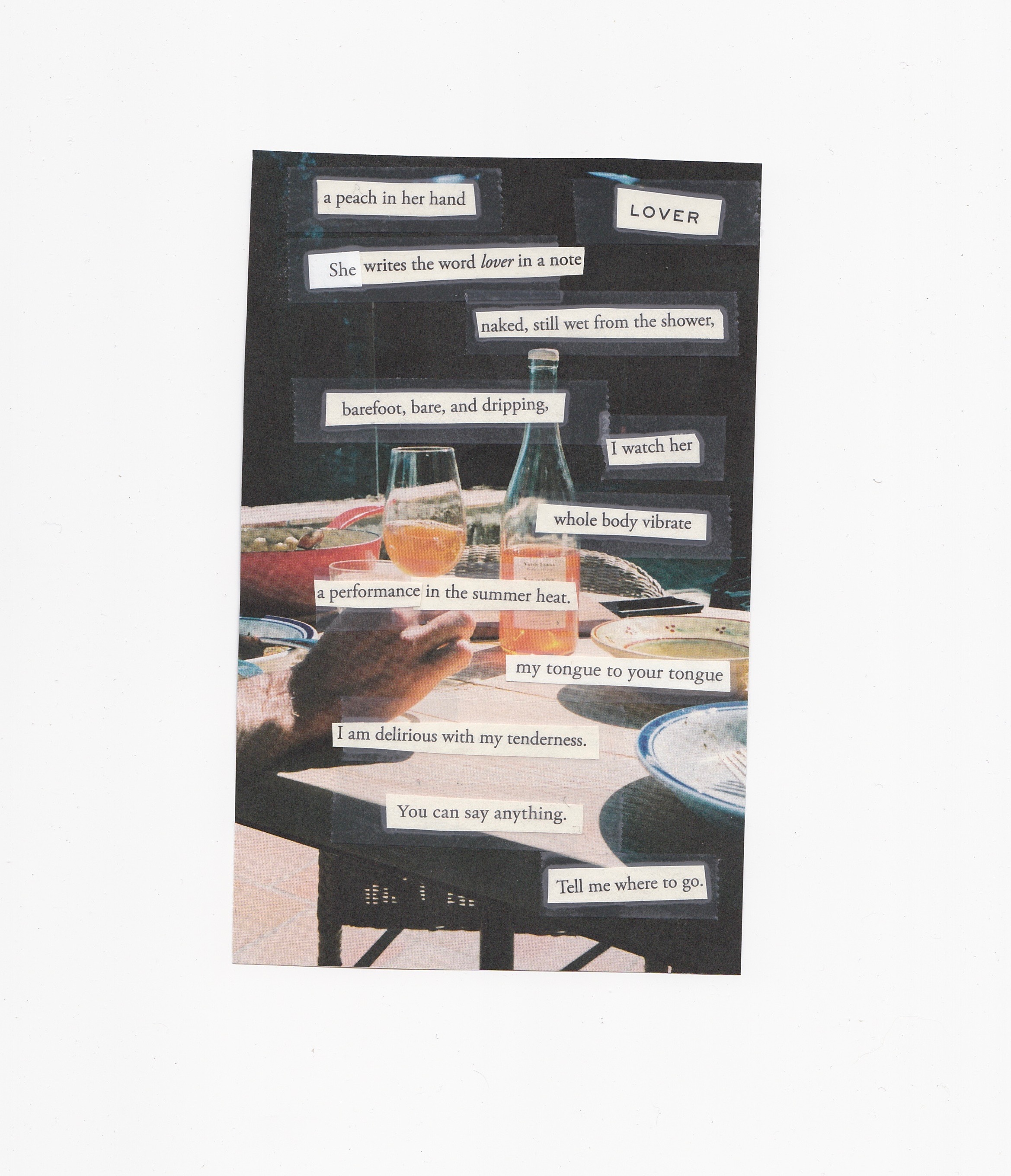
Would you describe your creative process?
I work as a nanny and a significant portion of my day is spent on stroller walks or shuttling children from different locations. I’m fortunate that stoop culture in Brooklyn, especially where I live is so abundant so I source almost all of my materials from what I find wandering around. My friends know that I am insistent on sifting through stoop piles and little libraries too. Wandering around with the potential of finding new items, I am a flâneuse of the borough making away with finds like handwritten love notes and vintage magazines.
Making these collages can be tedious, a result of not having enough space to sprawl out in my studio apartment so I have had to come up with an organized system of steps that can sometimes make my collaging feel antithetical to the creative process. Once I’ve collected a hearty pile, I’ll spend a weekend going through it all, cutting out words, images, and backgrounds and sorting them into color-coded sections in an accordion folder or putting the letters into fishing tackle boxes. This takes a few hours so I dedicate certain sessions to sorting and organizing and others to creating layouts or poems. This is more an organizational chore but every time I try to circumvent it, I get overwhelmed by excess paper and the disorganization of where certain pieces are.
If I am making a visual collage I sit in the middle of my living room floor and spread the materials I have recently been drawn to in one pile with my accordion folders, scissors, tape, and an exacto knife near me in a half circle. I will go through each color and pull scraps that I like then start combining elements from there usually taking photos on my phone of how each layer or potential layout looks.
When I am drafting poems, I set up at my kitchen table and individually line up the fragments across the table and leave a small window clear in front of me. This takes the longest to transfer the fragments that live in a green bowl on a side table (I tell friends who are over to choose one at random, ‘these are your tea leaves.’) to line them up so I can see everything at once. The fragments remind me of the magnets you could rearrange into sentences on the fridge as a kid. I won’t go into writing a poem with a specific plan but let my gaze land and see what phrases or words I am attracted to. (I’ve been wanting to write a poem about a hotel room for a while but quite literally have not found the words in what I’ve cut out.) It feels like a moment of submission in the creative process that can feel to rule or process-based for me at times. Of course, there is the influence of current emotions, relationships, or circumstances that influence my attraction to certain fragments. I’ll pick up those phrases or words and put them into the center opening and see how they fit and flow with the other things I have chosen. From there, I will play around with the cadence, grammar, storyline, and other elements of the poem before testing how it will look over the background. Once I am satisfied I will tape it down using scotch tape before scanning it.

Are there any other mediums you may wish to explore with your art in the future?
For the moment I want to focus on collage and text collage work and challenge myself to rewire some of the self-imposed rules I have gotten caught up in when making spreads and poems. However, I have recently been shooting more film to use them as the background photos. I’m hesitant to use images with identifiable people—friends or notable faces like a celebrity—because I don’t want the story to be completely revealed to the reader through the association they could have with that person. There is a level of anonymity that is required so the poem can feel personal and interpretable to the viewer. While some of the collage poems I created have been about specific people or my own experiences, there are plenty that are not. It would feel incongruent to pair a personal photo with a poem that was not associated in that way.
Lindsey is a low-income and chronically ill collage artist (analog photoshop, if you will) based in Brooklyn. This creative work sustains her left-brain creative practice as she prepares for medical school in the fall. Her most recent project was collage work for a book of poems, Venus in Pisces published earlier this year.

 VAGABOND CITY