In the June 26, 1948 edition of The New Yorker Shirley Jackson’s story “The Lottery” expanded the envelope of speculative horror—and prompted hundreds of readers to cancel their subscriptions. Letters and postcards poured in with subscribers offering their complaints and reasons, nearly all of them with an undercurrent of outrage at the supernatural events being rendered in such a way that the reader has difficulty deciding whether these events are truly supernatural. Today, of course, “The Lottery” is one of the most celebrated horror stories of all time, giving speculative horror a privileged place in literary criticism. In Em J Parsley’s novella You, Below Me, speculative horror is pushing up against that envelope once again, nudging it out just a little bit more.
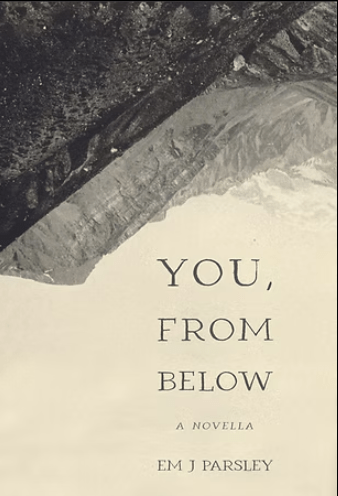
Our unnamed main character is sitting on “the sturdy side of the county line” staring in shock and disbelief at the smoldering crater where their town, Mission, used to be. The hole is shaped in a ragged cutout of the towns border, reeking of sulfur. There is a letter in their jacket pocket—the letter was not there that morning before the town was swallowed and in fact our main character doesn’t know how it got there. As they start climbing the mountain away from the obliterated town, they repeat to themself, “I have a message. I have a message.” They do not open the envelope, they don’t know what the message is. You, From Below is a bizarre fable of flight to an unknown destination with an unknown message.
This is Parsley’s first novella, his chapbook the anonym gospels won the Apogee Poetry Chapbook Award and he’s appeared in numerous journals and reviews including Silk Road Review and Every Day Fiction. Parsley previously taught creative writing at Eastern Kentucky University, he now hosts a monthly column at the Wild Roof Journal. His capacity to conjure and appreciate what lies beyond existence stems from his vivid and sometimes demented imagination. Kristen Gentry, author of Mama Said, calls You, Below Me The Wizard of Oz for modern-day Appalachia. Its second-person narration gives it an eerie twilit aura, evoking bewilderment and fear at the bizarre supernatural occurrences.
You, Below Me is a Canterburian journey—lone, solitary people/beings are encountered, seasons change and our main character journeys through heat and snow. The first encounter is with a beekeeper, or some sort of being in a beekeeper suit. Their face is never visible through the mesh of the mask. They beg to see the message, their voice turning into a static buzz as our main character attempts to flee. Like in Lauren Olamina’s journey in Octavia Butler’s Parable of the Sower, a pall of dread and the unknown hovers over everything. While Sower‘s Lauren wants to deliver a new religion to a place, our character here has an unknown message for someone or something also unknown.
Our main character ruminates from time to time remembering life before the collapse:
You were loved, and you were lonely, and you were not alone in this phenomenon. Your home, your family, friends, elementary school, were taken by the earth, and you do not feel any more lonely than the day before they were all taken away. Which is to say, you feel like you will never hold someone’s hand ever again.
They also of course ruminate on their mother: “If you had imagined up a Mama, you couldn’t have threaded the needle better.”
You, Below Me‘s journey is a weave of interiority and action—one of the beings encountered is a woman who is not a woman. “She’s draped in kudzu, more vine than woman and more trustworthy smile than vine, and she promises one thing and one thing only: embrace.” Our journey also comes upon a lone missionary in an abandoned town enduring her punishment of solitude and remaining faithful while waiting for a reward from God. “The real punishment would be to sit and wait and wait for an eternity that is never going to come, wasting the little eternity she has now,” our main character thinks.
At what looks like what may be the end of the journey—a forested plateau with a lake stretching to the horizon—our main character encounters someone they believe to be a man, but it’s a man with the head of a vulture. Our main character is certain that this is who the message is for and thrusts the envelope at him. He refuses it. Our main character insists and thrusts it again. The vulture-headed man opens the envelope, retrieves the message; but then puts the message back in the envelope. “It’s for you,” he says, handing it back. A penetrating poignancy colors the climax as ‘you’ looks into the lake and does not recognize the reflection.
For all its surreal shapeshifting You, Below Me still keeps one foot grounded in reality. “Breath comes with the duty to help others breathe,” the vulture man tells our main character. Themes may reveal an artist’s silent or latent beliefs about themselves, and Parsley’s story weaving creates a new skepticism for the real, robbing reality of its cynical beliefs of what it means to be lonely and what it means to be loved. Certainly, You, Below Me has a heft of despair and fear. Parsley’s form of speculative horror also probes our assumptions on life, the universe, and time. Lewis Carroll once said, “Some day, you will be old enough to start reading fairy tales again.”
Hugh Blanton’s latest book is Kentucky Outlaw. He can be reached on X @HughBlanton5.

 VAGABOND CITY