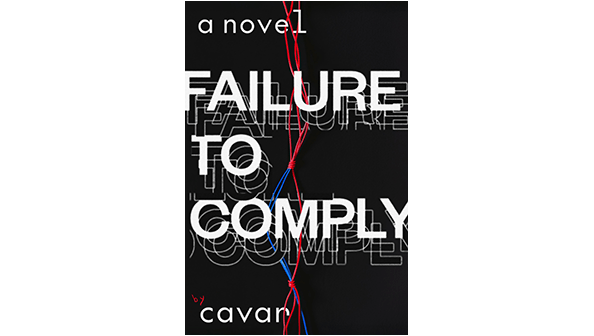
Cavar’s dystopian novel Failure to Comply, like all great science fiction novels, is a cautionary tale about the present cloaked in a story about the future. Despite its bleak setting of oppression and control by a corporation state, RSCH, Cavar’s novel might as well be taking place in Texas, Florida or Tennessee in the midst of far right legislative and cultural attacks on minorities and bodily autonomy. The novel is told through the fragmented perspective of an unnamed speaker with three arms and two stomachs and for whom language has been weaponized against, and erased. The future’s safety requires passivity, the most basic identity, and complying with RSCH, in all things, at all times. While Failure to Comply offers a traditional dystopian narrative, ultimately, Failure to Comply is a meditation on control, and control’s partner, language.
Cavar delivers readers a world devastated by climate change, war, and toxic waste, a world where humanity is rounded up into little enclaves owned by corporate nation states. A Big Faceless Corporation provides everything for citizens, for whom there is no freedom of expression. This world is pure, healthy. Deviancy is routed out through technological or sociological means, for RSCH’s obsession is purity. Its means of control, institutionalized ableism. To save the human race, apparently, RSCH adopted said standards, gathered its resources, its subjects and hunkered down in their corporate control and waited. RSCH is a system that does not allow for disability, deviancy, or even pleasure; skin to skin contact is banned, reproduction is achieved via technology before placement with the citizen’s mother and father. Nutrition is provided via shakes provided by RSCH, which also provides schools, entertainment, care. Citizens do not have agency over their body, so much so that citizens are discouraged to look at themselves in mirrors because they do not own their bodies, “the truth of our bodies is contained solely in RSCH documents, quantified by stats accessible by the contacts. To look at the body through such an unreliable glass became so taboo it was nearly (though not yet) outright illegal.” Under RSCH questions are prohibited, words are controlled, so much so that even the future tense is forbidden. “RSCH had our patent. They made us property. They had the exclusive ability to invent—interpret—the Citizen body”. The best way to control a citizenry’s body is to deny the citizenry language to define the body, to define identity outside that of control. Cavar reminds that words control, words lend power and engender everything in reality; the reader eventually learns that “The most powerful thing about RSCH”, the big bad in Failure to Comply, “is its words.” Echoing eugenics language from the turn of the 19th century, and TERF gender criticals of the 21st century, Cavar’s faceless RSCH is a corporate manifestation of homophobic, transphobic, racist, and xenophobic tropes set to a dystopian beat. RSCH indoctrinates, RSCH saves, RSCH provides. RSCH operates via anonymous medical professionals dispensing nutritional shakes and micro-managing aberrant behavior reported by RSCH’s many forms of espionage and data collection. A vast techno antagonist responsible for everything in this world, except for nature. The past is gone, there is no future, there is only the present.
Failure to Comply enters the narrative post apocalypse, the narrator a kind of rebel, a kind of free thinker who must be corrected time and time again by RSCH. Citizens participate in their own control. The speaker’s hyper awareness of control mechanisms creates tension, emotional weight. Control, via secondary reinforcers, is the only landscape. The oppressor, a sunny white washed sanitized techno fascist horror– where all citizens are aware, at all times, of who is in charge, RSCH, is the white noise that populates the novel.
While primarily a story of freedom from control, Comply is also a tender love story between the unnamed speaker and a citizen named Reya. “They held my ear to their lips, which brushed my lobes as they whispered. This in itself was flirting with danger. I felt a shiver reach each notch of my back in turn “ Love, of course, is the exigency for liberation of the self. Citizens in Failure to Comply, like citizens under oppressive regimes, report on each other, every strange behavior, every broken norm; purity, like heteronormativity, must be policed. The speaker’s love affair with another citizen, one who hides their disability, their pronoun choice, their identity and their illegal hormone use from RSCH, is as much of a threat to RSCH as impurity or deviancy. Pleasure is not permitted. Pleasure experienced with another person is a gateway to identity, for two people have contrasting points of reference converging from where their bodies interact; identity arises, and identity is a gateway to freedom. RSCH understands this. For Reya and our protagonists, such acts of love and resistance must take place in clandestine places, an echo from queer history and, for many, the present, and the speaker and Reya find themselves self-exiled in the wild, a natural landscape where non-citizens live. It is here, under the green, that people are allowed to live free, think freely, wield language, take any hormone they can find, and find love.
Humans are amorphous bodies in Failure to Comply, RSCH has bred humanity toward this, these amorphous easily controlled bodies. For either survival depended on it, or for reasons beyond the scope of the narrative, RSCH went down this road long ago, and in this novel hormone use is not necessarily tied to gender and transgender identity. Certainly, transgender identity informs, resonates and echoes out from Comply’s hormone economies, and is an analogy for the modern transgender and non-binary experience, but for the purposes of the novel, they are transgressions against RSCH, explorations and definitions of identity and freedom, as part of the wild life away from RSCH’s eye. In this world, Cavar’s characters have room to make meaning, learn new words without the baggage or wisdom of cultural infrastructures, for RSCH has erased such infrastructure to its basest form.
How does one resist where there are no words other than what is permissible under RSCH? Language is RSCH’s most powerful weapon, it’s most employed weapon, and it’s most invisible weapon. Composed in fragmented lines, found documents and intercepted exchanges and fragmented narrative/cognition, Cavar fashions a dystopian world where there is no history and there is no future, there is only the present. To illustrate this oppressive structure, the weaponization and erasure of language and its intersections with identity, Cavar employs syntactic flourishes, moments of lyric, and manipulates the text to both illustrate this dystopian world of RSCH and to engender the experience of those oppressed by it upon the reader. In this regard, Failure to Comply often echoes the neuro cognitive mimesis one might find in The Raw Shark Text, House of Leaves, or the work of Anne Carson or John Cage, where Cavar’s manipulation of the text imparts as much or more meaning than the words. The fragmentary syntax is both hallucinatory, unnerving, revealing, and often lyrical and elegiac. At times the words morph in the middle of a narrative section, for example bisected becomes sexed, hurt becomes herd. The effect is one of disruption upon the reader. At times, the narrator’s thinking and narrative style is choppy. At times, not, giving the readers the experience of living under RSCH’s controls. For the citizens of RSCH are engineered humanoids, and their language is engineered to be an amorphous code, for how can the citizens of RSCH be free if they do not even understand how oppressed they are, and that they are complicit in their own oppression? In this manner, Cavar’s novel reveals language is control’s partner.
Cavar’s control over language is luminous. Failure to Comply is stunning to read, insofar as that the text leaps. Cavar’s daring inversion of text expectations disrupts reading. The voice of Failure to Comply, a young gender explorative person, hiccups, gesticulates wildly, engenders the narrative with code, and lyric, a haunting flourish that amplifies the bleak spiritless place that is RSCH. Cavar’s wordplay engenders a hallucinatory, mirrored doubleness in so much that the landscapes of Failure to Comply are multi-faceted, but the main landscape is the human body, the speaker’s body, as she navigates existence.
One of the ways the speaker discovers freedom is through exploring that which she inhabits but has no language for, her body. Physical traumas, body dysmorphia, gender dysphoria, and disabilities haunt Failure to Comply, for Reya and the narrator, through their body play and discovery, create their own identities, try on identities and words for size, and thus free themselves from RSCH’s control. In this manner, Failure to Comply is a very traditional young adult novel, in that we have young protagonists finding their voice in the face of oppression. Comply tenderly, though certainly also violently, explores the experience of the mind/spirit’s education via the body. The body is the battleground, and viewed through the lens of modern conservatism: female, colored, disabled, queer, and trans bodies are the resources to be controlled, repressed, and erased. Love and resistance are the only options. “They are going to re-measure you this afternoon they will say they want you to go free & they want you to be good but your body was a failure and it was a shame because they want to protect their own. This is a lie. You can make yourself again.” Cavar’s eye, and the speaker’s eye, locked on liberation, looks to the future now, head on.
In Failure to Comply, words and flesh go hand in hand. Language engenders spirit which engenders body, together the two concepts are both the gaoler and the liberator. RSCH remains a ghostly antagonist, likely a research and development corporate wing that went rogue in the apocalypse or simply created this world hidden from the now, as they, the oppressor, worked on their world-building. In the end, words and flesh are undone as the narrator faces the axe, a literal cutting and cleaving of flesh, a RSCH action of control, its most obviously violent mechanism. But Cavar doesn’t wrap up the narrative, rather the narrative continues to fragment, mirroring itself. The speaker, isolated from Reya, isolated from love, wanders in the dark finally stumbling upon a citizen. Is it a memory? A fever? By the end of the novel, the narrator’s escaped RSCH’s language, and thus escaped time. “The Citizen looks disoriented…I recognize panic….I wonder how she could be panicking without RSCH intervention. She opens the box. Some blood spills out. She leaves the bloody box….returns with another. Once more, she exists exist exits to retrieve a box….She suddenly begins to tear the pages, tears springing from her eyes like violets. We know nothing…To swallow is to something like a burial. She swallows the pages whole…” This hallucinatory ending, a character ingesting language, for sustenance, as a kind of burial, language’s keystone keeps the architecture of the body aloft. Without language, RSCH wins.
Cavar’s uneasy novel ends where identity, language, and the body fail, a systemic collapse of meaning when body and identity are erased, policed, and corrected. Is the narrator liberated, or has the narrator become another feature of the system? Is the system part of the character’s memory, or is the character as defective and as deviant as she tells us she might be? The doubling and mirroring of power and character is intentional, without language, and the agency to command it, identity is as amorphous as the engineered bodies of RSCH; Cavar reminds that words control, words lend power and engender everything in reality; the reader, eventually learns, that “The most powerful thing about RSCH”, in Failure to Comply, “is its words.”
Cassandra Whitaker (she/they) is a trans writer living in rural Virginia. Whit’s work has been published in Michigan Quarterly Review, Gulf Coast, Conjunctions, The Mississippi Review, and other places. Wolf Devouring A Wolf Devouring A Wolf is forthcoming from Jackleg Press in 2025. They are a member of the National Book Critics Circle. Wolfs-den.page

 VAGABOND CITY