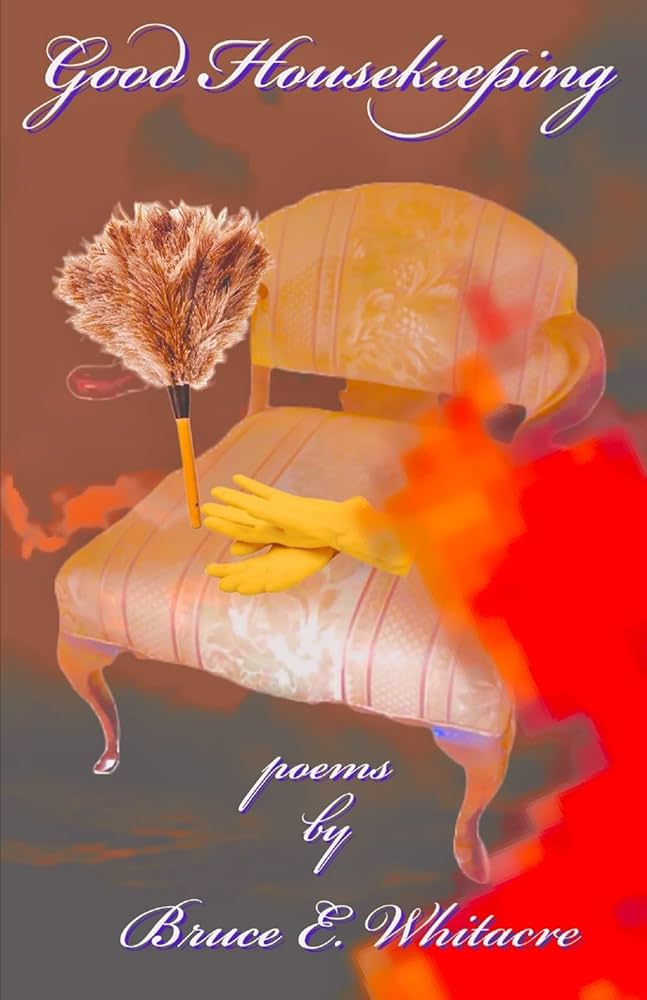
Bruce E. Whitacre’s latest book, Good Housekeeping, from Poets Wear Prada, explores the humanness of living inside the bedlam of urban existence. Life is full of elixirs when dealing with modern chaos, whether it be vodka, champagne, etc. But, at its core, people are the flesh, bones, and blood of beer. We seek shelter from life. We close the doors of our homes and within ourselves. The noise: bad news, phone calls and texts, the Internet’s persistence, and more. Our homes are our sanctuaries; our bodies, both the emotional and physical, living within the bodies of our households. Both require good housekeeping skills. Both require affection and consolation.
In two poems called “Narcissi, We Drown in Our Own Eyes” and “Mother’s Chair,” Whitacre talks about how we need love and comfort.
In the former, we feel the radiance for his partner in each of his eight couplets—a leisurely country drive, two gangly colts in love, being a safe harbor for a shoreline, being a contract written out of love, and so on. He sets the table, breaking bread and feasting on radiance.
The latter is about a son’s love for his mother, who still mourns her death. The chair becomes his mother. She wears a new dress of damask material. Her arms offer maternal comfort. Her seat becomes her lap, offing comfort to her son, and Whitacre falls asleep, feeling safe from reality’s bitterness. Each line, introspective and touching.
We travel on trains, walk the streets, both here and abroad, meet our past and present, the tensions and joys, the sadness of a reunion’s end. In Whitacre’s poem, “Once More for Elizabeth,” a dinner with a proper English girl leaves us with the “goodbye” that sends us into the void. Friendships fall apart because of geography, lifestyle changes, and lack of correspondence. When Elizabeth received visitors from her past, we found out that she wasn’t ready. Did she hide her private life or other embarrassing things that should be kept secret behind closed doors? She took them out for dinner, still wearing the same clothes as before. Out of her proper English upbringing, she paid for their meals. Her guests accepted, but later tasted the bitterness of the aftermath. After their goodbyes, she shut her door, returned to her solitary shell. Their promises to see each other, destined to be ditched inside the void. Whitacre’s poetry is about his and our metaphorical good housekeeping, whether on the home front or outside, or within ourselves. The theme of table settings, food preparations and servings, along with mundane household chores, aligns well with the daily “hunting and gathering” aspect of contemporary life. Good Housekeeping offers “food for thought” on how to make time for love and comfort and clean up the mess of life’s challenges that made us who we are today.
Patricia Carragon’s recent publications: Five Fleas Itchy Poetry, Fixed and Free Quarterly, Jerry Jazz Musician, Out Loud, an LGBTQA Literary Arts Anthology (Red or Green Books), When Women Speak Poetry Anthology, Vol. 1, The New Verse News, The Rutherford Red Wheelbarrow, The Scene, Soup Can Magazine, Spillwords, Wales Haiku Journal, et al. Her poem, “Wild Is the Wind,” received a 2024 Pushcart Nomination from Poets Wear Prada’s The Rainbow Project. Her debut novel is Angel Fire (Alien Buddha Press). Her books from Poets Wear Prada are Meowku and The Cupcake Chronicles. Her book Innocence is from Finishing Line Press. She hosts Brownstone Poets and is the editor-in-chief of its annual anthology.
Please check out her websites: brownstonepoets.blogspot.com and patriciacarragon8.wordpress.com/. Twitter:@ BrownstonePoets IG @patriciacarragon Linktree @patriciacarragon

 VAGABOND CITY