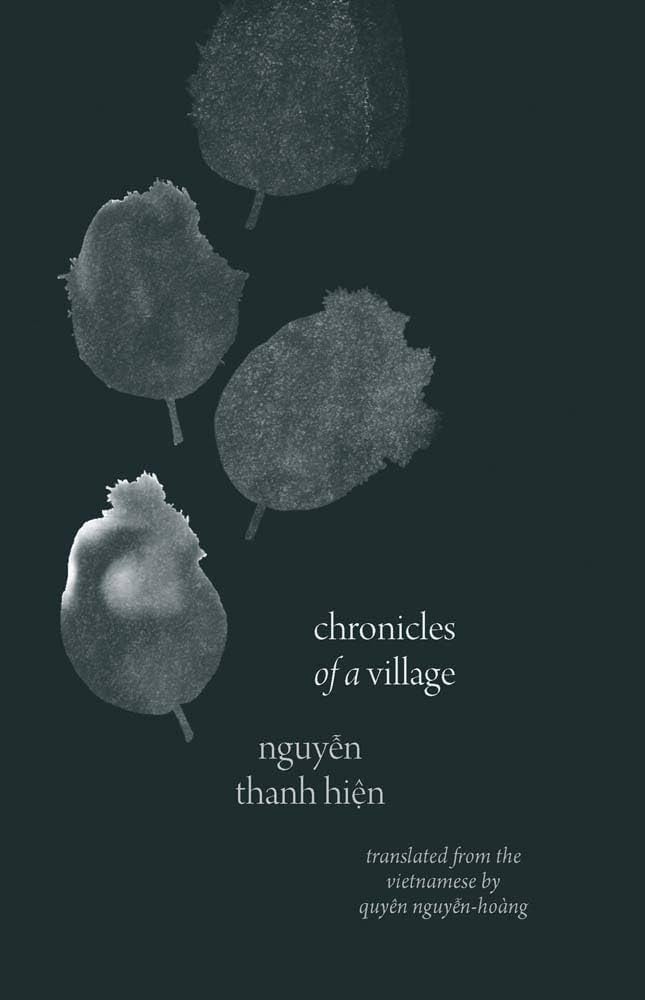
In the Translator’s Afterword to Nguyễn Thanh Hiện’s Chronicles of a Village, Quyên
Nguyễn-Hoàng describes the role of the translator as “someone trying to grasp not only the
rhythm or tone, but the scent of the text” (131). The scent of these words lingers with me after
reading Nguyễn-Hoàng’s translation of Nguyễn’s “timely and timeless” novel (130). Chronicles
of a Village is the particularly potent work of a writer whose village resonates across multiple
valences of space and culture, even and especially in its geographic and political specificity.
Nguyễn’s village is a place “where the placenta and umbilical cord were buried,” a
village once “known as the place where the cotton in the king’s pillows was made.” Says the
narrator, “as a child i got to sleep on the same pillows that the king himself slept on, cotton
pillows…nowadays the cotton pillows lodged somewhere deep in my memory sometimes
resurface like a messenger…” (54). The materials of the village give it vitality. The lives of
material things and beings, traced from beginning to end to beginning again, are what then hold,
and thus tell, the village’s history.
This is a village continuously beset by the march of progress. “Forward,” shout the
“sightless humans” in the first chapter of the novel. Villagers rally behind the “laconic
commander” who declares the “sole objective…to march toward a world without navigators”
(2). In contrast, the narrator writes a history. The narrator reflects on the ongoing “arduous
struggle for fabric and rice,” accompanied by the “occasional sound of words and meanings”
(50). Kings and lords and merchant-politicians vie for power over and around the village. The narrator reads the work of scholars who came before, tracing patterns of war and dynastic
turnover, of victors taking the places of different victors.
Nguyễn and Nguyễn-Hoàng tell a story with no beginning and no end—or rather, a stor
with many. The village chief is dethroned, but we do not know when. Foreign merchants “bribed
all kinds of kings and manipulated all kinds of lords,” but we do not know when” (52). The only
dated moments are the excerpts from written records by scholars, yet even these selections are
presented in juxtaposition with the stories of the narrator’s father, with the narrator’s
memories—all as possibilities and as multitudes, existing rather than competing for supremacy.
The result then is an ongoing and deliberate refusal to adhere to colonial time. Nguyễn and
Nguyễn-Hoàng pursue other languages for naming, and writing, the history of the titular village.
Perhaps the text on historical method is Michel-Rolph Trouillot’s Silencing the Past:
Power and the Production of History. Trouillot’s primary argument is that narrating history is an
act of power. Power enables the telling and popularizing of a narrative as the truth—as history.
Power is the currency wielded by the people who would fashion themselves authorities through
it. This power can be wielded in any direction; the point is that it becomes the means and conduit
for conducting the writing of history.
The question of narrative comes from my own dilemma as a translator—sometimes of
text, continuously of daily experience between individuals, populations, and ideas, all of whom I
hold dearly. In this dilemma of constant, unsettled negotiation, it is too easy to fall into a futile
quest for origins: where did I come from, and where can I rest? More primally, who is to blame
for my conditions? I am not invested in the pursuit of causal explanation, if I ever was, and
neither is Chronicles of a Village. There comes a point when identifying some source of temporal
origin will not solve any problems or bring about any more clarity to the predicament of a place.
That is, at what point does the pursuit of history become the hunt for a scapegoat that can be
called the truth? As the narrator’s father says, “history is only a draft copy, son, nothing is
certain, nothing is true” (126).
What is history, then, if not power? Can a story be told otherwise? What would such a
story sound like? Poet Marianne Chan writes her own response—or rather, her lola’s—in her
poem “Counterargument That Goes All the Way Around.”
I do not wish to go backwards…I want the future, where / nobody can see me, where I can
be alone with myself, my M&Ms, / my America, my years, increasing with each drag of
the Capri cigarette.
Chan and her lola are not interested in progress. Their future is not a linear destination,
but a different plane of peace. To aspire to or believe in either some future or retroactive paradise
is to adhere to the belief that all roads—forward and backward, eastward and westward—lead to
a salvation hinged on colonial conditions. A never-ending story, a never-ending war. The
Vietnam that “emerges” out of these never-ending conditions as a seemingly distinct outcome is
then, in fact, part and parcel of the march of history. As the narrator says, “one returns to the
homeland to escape history but it’s impossible to escape” (68).
In a communal reading of the first chapter inside a friend’s living room in New Haven,
Connecticut, our gathering of local writers, readers, and lovers of words shared our responses to
impactful phrases, images, and details in the text. I was struck by the image of the march of the
sightless humans. I noticed aloud the frustration of not being able to pinpoint the allegiance of
the sightless humans. The reader, the listener, feels the unresolved anxiety of not quite knowing
which party, which side, to sympathize with. Meanwhile, the social scientists provide something
akin to a chorus, looming over and commenting on the events, offering their theories and diagnoses. They make their conclusions about the fates of the villagers and the causes of these
events. They write the narrative, and they write it by wielding power over its players.
Chronicles of a Village speaks to the dangers of stories written through state power in its
many and varied masks. Resisting myopia at the same time as not making judgments about the
future is a difficult balancing act that requires careful humility. Chronicles, then, is one example
of a writer and a narrator who makes a significant effort to do so.
Karis Ryu is a writer based in New Haven, Connecticut. She is currently pursuing a PhD in Religious Studies at Yale University. She enjoys searching for odd stories in odd places and is working on a novel. Find her perusing a used bookstore, humming over a piano, or at karisryu.com.

 VAGABOND CITY