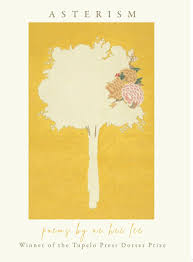
Twice in my life, I’ve felt the embrace of Trujillan sun warmed-sky: first, upon my return to my home country after many years away and, most recently, through Ae Hee Lee’s gorgeously bewildering debut.
Asterism opens with an epigraph from Italo Calvino’s The Invisible Cities, setting the stage for an exploration of the human condition through layers of culture, language, memory, and time. The collection contains knowledge at and beneath the surface: everything conceals something else. These poems drive, dig, and invite the self and reader into this wonder: “Maybe the unknown is but a hard mirage of what’s known” from beginning to end. This invitation and interrogation expand a journey through the halls of memory and belonging that moves seamlessly through registers and forms within imagistic narrative and dream-state lyric.
The vignette-like stanzas of Dream Series of My Mom Making Kimchi in Trujillo weave a captivating narrative that introduces us to the connection between the speaker and her mother. This poem grabbed me as a reader by probing the intricacies and difficulties of what it means to belong, grieve to assimilate, and exalt personhood through intuition:
“her philosophy that a fixation with authenticity deters one from pouring jeong into the food” And preservation:
“ rare like the Korean pepper flakes my mother has been saving by mixing them with ají panca.” The speaker bridges the distance gap through the ingredient that cannot be seen, jeong.
And what cannot be seen is vividly alive in my heart as a reader through their connection. I am left in complete awe of the loving exercise of cultural preservation.
Lee fearlessly navigates her languages, not afraid of othering the reader through them but sharing the possibility of finding yourself between them at the interstice. In Road Trip, Lee demonstrates her masterful use of form as the vessel where empathy through words flourishes:
“but a September moon is out early to overhear us
La tristeza que le sigue
sing Bacilos’ ‘Caraluna’ in unison.
Poco a poco esta sencillez de sentimientos
The rearview mirror diligently catches
Estoy segura que desvanecerá”
Spanish and English intertwine seamlessly, offering multiple layers of interpretation and engagement with the poem. Through my languages, I can access the image of a rearview mirror and sorrow vanishing into the night at the tune of a band that places us in a world far from here but always in my heart. The poem cements the sensation of the world as large and small simultaneously.
The speaker’s journey through the poems reminds us that language and experience are often difficult to match; Asterism is brilliant in demonstrating that there can be gain in discomfort within language, the possibility and acceptance that a translator can be a traitor, as stated in one of the epigraphs to the closing poem, Prelude. As the poem progresses, the Korean between Spanish does not push me away. Still, Lee nurtures the reader into a profound final embrace with the utterances that carry you across the collection so they may translate the speaker for themselves and feel close enough to question her as birds might question each other.
Alonso Llerena is a Peruvian writer, translator, visual artist, and educator. He has earned his MFA from Bard: Milton Avery Graduate School. His work has appeared in Prairie Schooner, The Offing, Ninth Letter, FENCE, and elsewhere.

 VAGABOND CITY