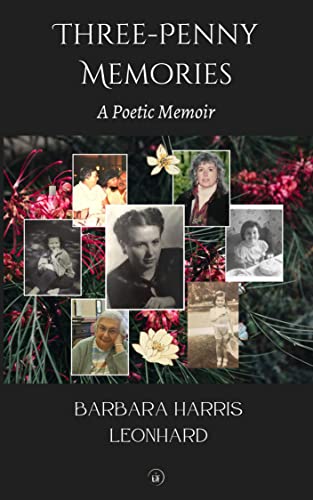
One thing a reader is struck by in this sequence of poems, divided into sections, is how well each poem stands on its own. This book is about a mother, a daughter, a family, and a mother-daughter bond, bears, like other good books, the stamp of necessity. What sets it apart is particulars, its individuality, one particular being the author’s mother’s birthday, February 28th.
Another, and quite different is the measles-encephalitis that afflicted the author in her childhood. Ultimately Barbara Leonard has given her readers a book life. Three things that characterize it are intimacy, spareness, and celebration.
Intimacy is found in form and arrangement. The poems give an impression of a diary or a journal, with their names, dates, and familial contexts. There is continuity in their arrangement. Often, one picks up where another left off, yet, as stated, each is an entity unto itself. Intimate and inclusive. “I Love You So Much It Hurts begins joyfully:
“Thereby hangs a tale, Dad writes,
announcing the birth
of his youngest, the seventh,
9 pounds 3 ounces,
at 2:45am on Mother’s Day, 1961.
What follows is an account of the mother’s travail, “Nearly a three-week hospital stay,” and her family’s, “Vacation time for Dad to cook, clean/ tend to the baby. “Mother’s Light,” the poem that begins the collection, consists of two sections. Its first line “Mother’s light guides me to her” gives the impression that the poet’s mother has passed on, that she has shed her mortal skin and is now all spirit, a new being. The poet concludes, “Creation of life and love/is as chaotic as star birth. The following poem, “Hyperion Raises Doubts,” sets the tone for much of the book. It begins, “You love her? My uncle asks.” What an odd One gets the impression they are at a funeral, also that they knew “her” well, and that the uncle knows his niece well enough to ask this question that, for all its intimacy, puts the reader right there with them. Leonhard, consistently, in her poetic constructs, invites people in. The words “Do you love her?” are picked up again in “Daughter, Like Mother.”
For spareness, selectivity, her chief poetic tool is synecdoche, the part representing the whole. In “Hestia for Hire,” the poet-daughter is a visitor in her parents’ home. The aging parents are depicted in this light: “Their separate recliners./ Mom’s endless romances.” Their sedentary roles contrast with the daughter’s mobility, her washing, vacuuming, her being healthy enough to do those chores. The poet-daughter herself, in a childhood memoir, is depicted as a doll, a thing a child would carry so it seems part of her. In “My Memoir as a Doll” the author’s travail as a child afflicted with encephalitis is rendered poignantly by Leonhard’s use of synecdoche. Here is part IV.
I awaken to the cold blast
of a burning heaven. White figures hover.
I repeat their prayers. They rejoice
about pulling the strings
and pose this Paralyzed Barbie
under a sheet.
Ultimately, this book is a celebration of the author’s mother’s life, a life that revolves around others. In “Our House of Hungers” the author’s father has left for Princeton to take a degree in theology, and the family has moved back to his ancestral home. “Alone with seven kids/ Mom resolves this sacrifice. And what was she like? She liked to cook, shop, play bingo, attend church, and thrive in her role as a minister’s spouse, which did not conflict with her being a fan of rock idyll Elvis Presley. If you don’t know you can’t care. A reader comes away feeling a sense of this woman and of her daughter.
It is said that to know success a person has to know failure. To know joy, one must also know despair. Three-Penny Memories: a Poetic Memoir is not a cheery, feel-good read. The author’s mother succumbed to Alzheimer’s disease. And that ordeal is poignantly rendered her, the mother’s gradual decline, the daughter’s wishing she could do more, the daughter’s guilt, though it seems she’s done all she can do. “Do you love her?” This book is a perfect example of someone writing to discover. The author remembers and celebrates in words, in what she says and how she says, in poems that had to be written, and were written for all of us.
Peter Mladinic’s most recent book of poems, The Homesick Mortician, is available from BlazeVOX books. An animal rights advocate, he lives in Hobbs, New Mexico, United States.

 VAGABOND CITY