“Lived and died a fat seven inches from your closet / toe. The gray heads of rainwater blown in. I / fought my own omens, their circles” (Moore 1).
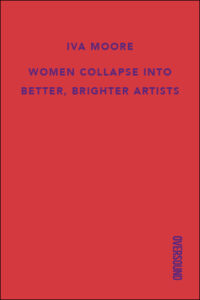
And so begins Iva Moore’s debut chapbook, Women Collapse into Better, Brighter Artists, a work that deftly examines gendered identity and relationships, womanhood as an inherently artistic/political act, all the while allowing for beautifully understated moments of insight and revelation, each in the author’s uniquely plain-spoken, poetically refreshing staccato voice, all prefaced by equally intriguing titles (e.g., “I Love Silence,” “Two Alices,” and “And Dread”).
Take, for example, Moore’s poem, “Edith Scob,” a titular nod to the late French actress best known for playing the facially disfigured daughter of a plastic surgeon intent on performing a face transplant on her. In only twenty-five verse paragraphs, with such arresting couplets as “they made / a complete candle / they made a complete / candle out of me” and “the athletic grace / it takes to turn / a woman / into a woman,” the author, using such a fitting (if somewhat relatively obscure) cinematic allusion, questions the ideas of beauty and ugliness, implying the real horror lies in the standards and roles women have historically been judged against and forced into, respectively, and admittedly still are (ibid. 6). Not only that, but in monostiches like “tho I did stare / like a man,” the speaker not only implicates herself but, by extension, the readers themselves, suggesting a responsibility on everyone to help make a less sexist and misogynistic (and more equitable) society (ibid. 5). In the hands of a lesser poet, such intentions could have easily turned didactic. In Moore’s skillful hands, though, such implications are present but artfully subtle.
The same is true of the first of her titularly titled poems, “Women Collapse into Better Brighter Artists,” another piece of free verse in which similar subjects are addressed and questioned: “Ever since I quit the pill, / I’ve gotten prettier, meaner, and happy. Legally, I have changed my name to Cecilia. / Cecilia Vicuña was born in nineteen forty eight, / like my father. And like my father, I wanted to accomplish myself” (ibid. 8). As with “Edith Scob,” the speaker of “Woman Collapse into Better Brighter Artists” references another public female figure, a Chilean poet whose art and political activism put her at odds with the violently installed Pinochet regime, causing her to flee her homeland, in 1973. Like Vicuña’s self-exile, the speaker’s legal name change, as well as her decision to quit taking one of the most popular forms of birth control, becomes a revolutionary act, an act of creativity and liberation (an interesting symbolic inversion in the case of the latter, given the pill’s historical role in the Sexual Revolution and second-wave feminism). As the speaker freely and unapologetically admits in the penultimate verse paragraph of the poem, “In a pure but rigorous display of aggression, I / inserted a complicated memory” (ibid.).
Where Women Collapse into Better, Brighter Artists is admittedly slim in length, it is incredibly rich in content and subtext. It is compelling in both what is offered, only hinted at, and even withheld. Try to find titles that don’t intrigue you. Try to read Moore’s chapbook just once. Try to come away uninformed, unimpressed, unchanged. I dare you.
Originally from San Antonio, Texas, Jonathan Fletcher holds a Master of Fine Arts in Creative Writing (Poetry) from Columbia University School of the Arts. He has been published in Acropolis Journal, The Adroit Journal, Arts Alive San Antonio, The Bayou Review, The BeZine, BigCityLit, Book of Matches Literary Journal, Catch the Next: Journal of Ideas and Pedagogy, Colossus Press, Curio Cabinet, Door is a Jar, DoubleSpeak, Emerge Literary Journal, Encephalon Journal, -ette review, Five South, Flora Fiction, FlowerSong Press, fws: a journal of literature & art, Glassworks, Half Hour to Kill, Heimat Review, The Hemlock: A Literary Arts Journal, The Hooghly Review, Hyacinth Review, Infrarrealista Review, The Institutionalized Review, LONE STARS, Midway Journal, The MockingOwl Roost-An Art and Literary Magazine, MONO., Moot Point, The Muse, Naked Cat Publishing, The Nelligan Review, The New Croton Review, New Feathers Anthology, Novus Literary and Arts Journal, OneBlackBoyLikeThat Review, The Opal, Open Ceilings, Otherwise Engaged Journal: A Literature and Arts Journal, The Phare, Ponder Review, Quibble, Rigorous, riverSedge: A Journal of Art and Literature, Route 7 Review, The San Antonio Express-News, San Antonio Living, San Antonio Public Library, Speakeasy, Spoonie Press, Synkroniciti, Tabula Rasa Review, The Thing Itself, TEJASCOVIDO, Unlikely Stories Mark V, Vagabond City Literary Journal, voicemail poems, Voices de la Luna: A Quarterly Literature & Arts Magazine, Waco WordFest, Whale Road Review, When the River Speaks, Wishbone Words, and Yearling: A Poetry Journal for Working Writers. Additionally, his work has been featured by The League of Women Voters of the San Antonio Area and at the Briscoe Western Art Museum and the San Antonio Museum of Art. In 2023, his work was also chosen as a finalist for the Plentitudes Prize in Poetry. That same year, his work was also chosen as a finalist for Synkroniciti’s Poetry Prize for its Issue, “Broken.” He has also been nominated for a Pushcart Prize. Additionally, he has served as a Columbia Artist/Teacher for New York City’s iHOPE, a specialized school for students with traumatic brain injuries, as well as a poetry editor for Exchange, Columbia University’s literary magazine for incarcerated writers and artists. In 2023, he won Northwest University Press’s Drinking Gourd Chapbook Poetry Prize. Currently, he serves as a Zoeglossia Fellow.

 VAGABOND CITY