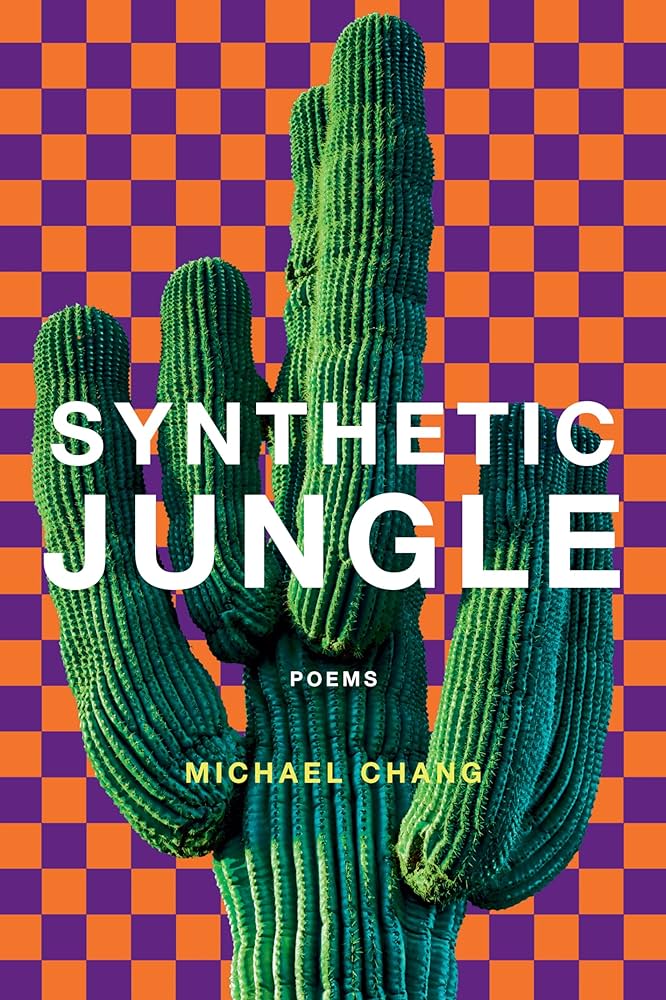
If I had to describe Michael Chang’s Synthetic Jungle, I might point to the opening line of
“白球鞋 WHITE TENNIS SHOES,” “‘poetry of the everyday’ means boring poetry.” It’s funny,
pointed, and true, the type of highly quotable line you want to share with all your friends and all
your enemies. It’s also fascinating because Synthetic Jungle feels very much like a book made
up of the everyday, not because its poems are autobiographical, or prosaic, but because the
material they’re composed of, their language and objects and events and structure, all feel
deeply bound up in a person’s life, their environment, and way of speaking. The result is poems
that draw you in even as they’re made for more than mass appeal, buzzy and bright and built to
enjoy but with a certain wildness and mystery too, a blend that stands out in a sea of poems that
can feel so collective they lack any sense of vitality or surprise.
All that’s needed to illustrate this point is a side-by-side comparison. In the poem “MY
MOTHER SAYS I’M TOO ROMANTIC,” Chang mentions some common elements of the poems
of Arthur Sze, which could easily be a stand-in for similar objects in many other poems:
“red-tailed hawk, red-winged blackbird, heart-shaped leaves, hare’s fur, assorted arroyo &
bougainvillea”. Now compare that with the first few lines of Synthetic Jungle’s second poem,
“CADUCITY”: “the syphillitic priest // that creep malcoln gladwell // the decimating, ravishing,
absolutely unwavering straightness of a hemsworth // rukeyser’s cry for ‘no more masks!’ not
aging well.”
Synthetic Jungle is packed with lines like these, lines made up of poets, celebrities, art,
politics, internet shorthand, and a bevy of sex jokes, all coming together to form poems that
warp and coil from line to line, humor flipping into earnestness into vulnerability into
disaffectedness and back again. Not only does this already stand out on its own, these materials
are deployed in witty, entertaining ways that reward both alertness and deep attention, like a
conversation with an especially smart friend, someone who can put ideas you’ve rarely considered in ways designed to stick in your head (like the ending of the poem “BEST BUDDIES, 1990″: “The feeling vs the image: ‘face down ass up'”).
Some people look at these traits as a type of signaling or posturing, and they get worried
about or annoyed by not being fully in on what they think may be one big joke. Others look at
the poems’ fast pace, their pop-culture references and shorthands like ‘u’ instead of ‘you’, and
try to root the book entirely in the internet or social media. Both framings ultimately miss the
mark. Though Synthetic Jungle’s poems stand out for their subject matter, humor, and tone,
they’re ultimately less about standing out than they are about capturing the present moment and
what it’s made of. We’ve lived for years in a time where we’re inundated with information from all
fronts, one where we’re sent celebrity gossip and major world news in the same second and
spending increasing amounts of time tethered to the digital world. If poems that capture and
respond to this reality stick out in the poetic landscape, it says less about them and more about
the ways in which a lot of poems, and literature more broadly, opts to avoid facing this reality at
all, like a novel that is set in the past just because the presence of cell phones would mess up
its plot.
Chang’s fearlessness in taking on these subjects speaks to an openness and receptivity
both in thinking about what constitutes a poetic subject and who its audience should be. Chang
has spoken previously about wanting their poems to feel engaging to anyone who happens to
read it, not just those who frequently read and write poetry. This commitment leads to poems
that reward all levels of reading, bringing the reader multiple levels of pleasure and enjoyment
even in the course of a few lines.
This openness also extends to shifting forms and subject matters, with longer prose
passages appearing at intervals throughout the book, including the highly memorable “U.F.O. &
DOLPHIN, 1982,” a reflection on the legal processes underpinning the murder of 15-year-old
Sergio Hernández by US Border Patrol agent Jesus Mesa. In the hands of a lesser writer, such
moments could feel random, especially given their formal and tonal difference from other sections of the book, but they are instead right at home with its broad-mindedness and wide
scope of engagement with the world.
Ultimately, Synthetic Jungle is its own wondrous landscape, able to hold the full range of
Chang’s interests, thoughts, and perceptions, on love, language, and modern, everyday life.
Rather than buckling under its ambitions, it ends up a rich and engaging book for its strivings.
For those seeking something fresh in their poetry, and who are willing to open themselves up to
it, Synthetic Jungle readily rewards exploration.
Gabriel Oladipo is a writer living in Chicago. He received his MFA in poetry from Brown University and is the author of the chapbook Emma (Ghost City Press 2018). You can find him at gabrieloladipo.com

 VAGABOND CITY