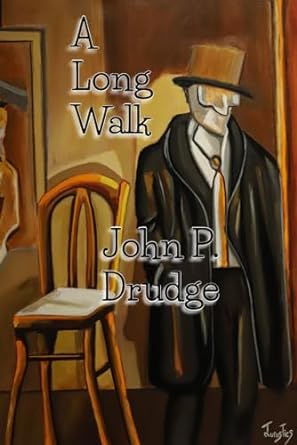
A first impression: the poems seem so impersonal as to be deeply personal. Words that resonate: sun, meadow, redemption, tomorrow, promise and…what else? Wandering and moon. A Long Walk is birth and death, fate and will, time and love. Spare, essential, intimate, each poem takes on a personality. Picture a human figure crossing an inner landscape. One thing common to these different poems is their vertical, down-the-page thrust that mimics the human. For a good appreciation of Drudge’s poems, their rhythms, syntax, and metaphors are worth noting.
Underscoring John Drudge’s rhythms is the line “We think by feeling. What is there to know?” from Theodore Roethke’s villanelle “The Waking.” Drudge’s rhythms play a big part in what there is to know. “Scorched” is a good example. The two syllable-four syllable “Faulty circuitry” followed by the three syllable-one syllable “haphazard zaps” sets up the poem’s conclusion: Into the thin wild/ Leaving us leathered/ And parched/ In our waiting,” rhythms that reinforce “the screams/ Of our times.” In “Scorched” the land is arid, its people walking “In a mist of moral emptiness.” But there are also lush places, where the sojourner is “One with the willow/ And the whispering/ Pine.” The rhythms reinforce rest, ease, contentment. “Drum”is a significant word in this book. Knowing comes from experience, from feeling.
As with rhythms, Drudge manipulates syntax to evoke a particular tone in each poem. “Not Everyone” begins with a complete statement: “Everybody suffers,” followed by “Not everybody learns/ Victimhood/ Is not enough.” The word “Victimhood,” placed as it is, links the second and third idea: Not everybody learns victimhood, and Victimhood is not enough “For truth/ To ring out/ Over roads of bones/ And rivers of blood.” Drudge’s syntax makes the language compact, packing the maximum amount of sense into the spare, minimal lines.
A third thing that makes the language compact is metaphor. In the first poem, the poet-traveler arrives at “the bridge/ Washed out/ In the spring.” To get there, the traveler stumbled “over rocks/ And roots/ And missteps/ On the footpath/ Of history’s forming. Like the traveler, a walker, a work-in-progress, history too is ongoing, in progress. Edward Abbey in his classic Desert Solitaire says to see anything you’ve got to get out of the car. John Drudge might add, to feel anything a person must be grounded, moving forward on history’s footpath. Other metaphors that lend solidity to the traveler’s inner landscape: “canyons of our movement, the debris/ Of cast-off souls, the lush motherhood of forgiveness” and “the edge/ Of my awakening” are land-related, and contrast with the “keyboard companions,” who in their “tenuous togetherness in “After the Fury,” are isolated. Figuratively speaking they “stay in the car,” pushing buttons, looking at screens.
The moods in A Long Walk are as varied as the moods in a person’s mind. And moods come from feelings, are feelings. Each poem’s mood is in part a matter of rhythm, syntax, metaphor. Here is
Waiting by the Pond
At night
The bullfrogs
In my pond
Are very vocal
Eager for something
In the cold charcoal mist
Of another hawing
Tomorrow
They speak to me
In a blunt
And pleading way
As I sit
In the icy black
Of the night’s
Forever
And wait for you
Another poem “The Words” begins, Words/ Make our lives bigger.” John Drudge’s words are carefully crafted, so in his poems he sounds like himself, and himself only. “Certain” is a significant word in A Long Walk. Any reader who takes that metaphorical walk with the poet comes away certain there’s no other book in contemporary poetry quite like this one. It’s well worth the journey, well worth the read.
Peter Mladinic’s most recent book of poems, The Homesick Mortician, is available from BlazeVOX books. An animal rights advocate, he lives in Hobbs, New Mexico, United States.

 VAGABOND CITY