

Occupying the tenebrous space between dreams and memories, the collages of JC Alfier (they/them) are at once intimate and mysterious; universal and obscure; conscious and unconscious. Evoking both the ubiquity and elusiveness of Jungian archetypes, this poetic opposition between the known and the unknown is brought to mind in La ville qui regarde II – The Gazing City II. Upon viewing the small text which reads, “Let’s walk along this lane,” one can’t help but feel invited to tread along that very division of consciousness. This month, Alfier pulls back the curtain and offers insight into their creative process.

How did you get your start as an artist? What drew you to collage in particular?
I got started roughly a year ago at this time when I was taken in by the art of Belgian collagist Katrien De Blauwer. Her work held such mystery for me. I was mesmerized. Since then she’s been my muse and exemplar.

Carl Jung’s ideas, especially those relating to dreams and the archetypes that inhabit the unconscious mind, have been cited as influences on your work. When putting together a collage, do you ever try to depict a specific dream you’ve had? Or are you taking more of a spontaneous, automatic approach? What is your process?
I’ve had dreams in which I’m spectrally or elusively female – like a transgender doppelganger, but mostly my creation equates to that spontaneous, automatic approach you mention; that is, I find when I array the photos on my work table they seem to draw themselves toward each other to be rebirthed in collage. Sometimes it’s a long process. I can’t always explain it. The photos often sit on my worktable for weeks before my mind’s eye catches them and begins to render a visual language from apparently disparate or disjointed pieces. But the motivation behind each collage is the approximately the same: I look to create with the intention they become a bit mysterious, reassembled into new narratives from intimate yet anonymous image fragments, and suggestive of emotional pathos — like a shadow text, or understated intimations. This is also the reason faces are obscured; not to hide identity, but to universalize the images: they are not one person, but potentially all people. Like the late Deborah Turbeville, I like creating photographic fictions that emerge from the assembling of collages, especially to evoke moods, not plots. Mine is an art in fragmentary discourses. Hence the reason some pieces are given conversational fragments as titles. I look to enhance the fragmentary approach by using colored backgrounds that exhibit torn or frayed edges. That is, a kind of cinematic disruption.
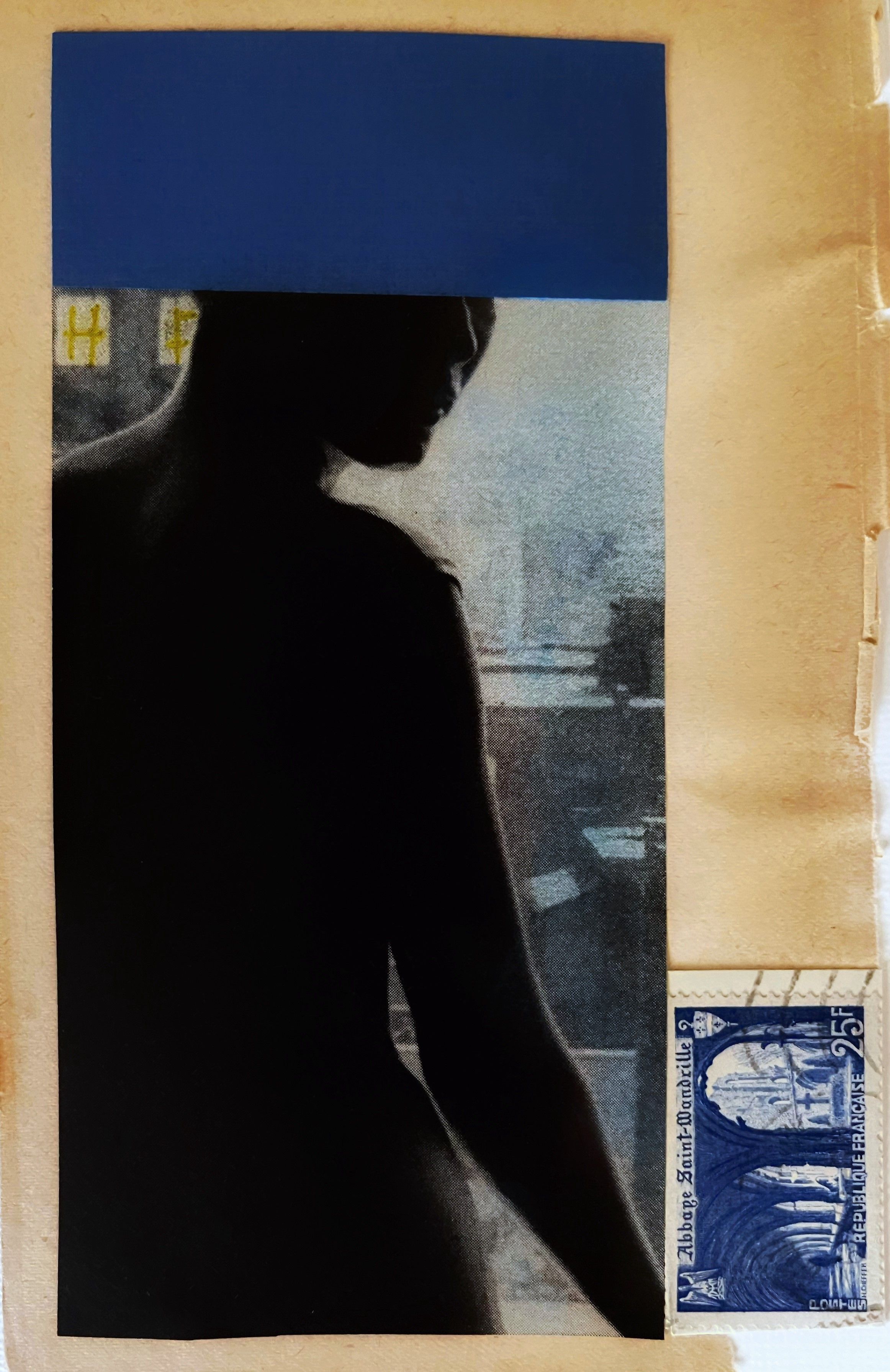
Your collages feature monochromatic photographs, sometimes accompanied by dashes of color, most notably shades of blue. Jung once described color as “the mother tongue of the subconscious.” Is there any significance to the colors you choose to include in each collage? Is it intentional?
With regard to color usage, oftentimes a color presents itself as a border to accent something I can’t quite identify except to say they reflect or implicate subtle emotions, or even pathos. Veiled sensuality lies in the red border and lips in one piece, and in another, purple accents fingernails. One collage calls for a blue strip of construction paper for the background, or fringes of the joined photos, while another calls for red. Beyond that, I employ a lot of blue because for me it suggests obliquely sad or sensual moods. Sometimes hints of color are applied through pastels chalk or colored pencils. Color can accentuate and obscure what is not directly stated, like the colors of a noctilucent cloud at dusk. There is also some oblique cinematic influence, particularly from film noir and French nouvelle vague.

You’ve mentioned before that you are drawn to the concept of “negative capability.” As both a poet and a visual artist, how does this affect your work?
The negative capability manifests itself – both in my poetry and collages – in that uncertainty, obscurity, or doubt without any reaching for resolutions. For poetry that mainly refers to the last line(s). Without a named or directed resolution, such as telling the viewer of my collages exactly what I’m depicting, I allow views to form their own narratives. Thus there is no resolved narrative, per se, as the viewer makes their own associations that will often reflect themselves in unintended or random ways.

Is there anything you’d like to further explore with your art? What are your plans for the future?
For the future, I want to continue my learned processes but also explore new ways of manifesting them. I like what New York artist Willa Nasatir said about her work, that “I’m happy that my work still feels mysterious to me, that it doesn’t feel solved or like I’ve reached the edges, the contours of the thing.” For me, that could mean using color photography and employing more double-exposures into my work. I’m excited to see where my imagination will go in the future, how my art will unfold. I live the LA area and I’d like to get back out to the Mojave Desert sometime soon and take photographs of shuttered mines and wildflowers and see how I may be able to work them into future collages.

JC Alfier’s (they/them) artistic directions are informed by photo-artists Toshiko Okanoue, Francesca Woodman, and especially Katrien De Blauwer. Their most recent book of poetry, The Shadow Field, was published by Louisiana Literature Press (2020). Journal credits include The Emerson Review, Faultline, New York Quarterly, Notre Dame Review, Penn Review, Southern Poetry Review, and Vassar Review. They are also an artist doing collage and double-exposure work.

 VAGABOND CITY