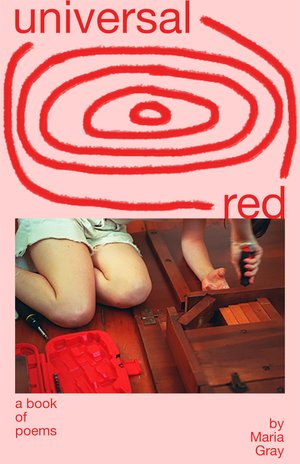
Sharp and utterly human, Maria Gray’s debut chapbook “Universal Red” (Ghost City Press, 2023) is a blade to the heart that seeks to turn a personal story of grief into a history of survival. As a survivor and victim of sexual assault, I shed tears reading these visually enticing poems. Beginning with a poem that acts as an ode and nod to Marina Abramovic’s performance piece “Rhythm 0,” Gray introduces us to a bleeding protagonist who has become a “crumpled form a monument to its murderers” accentuating the grief-beaten state of the girl, desperation echoing in each word and line which only grows to become stronger throughout the book. Gray forms words from blood as if she is crafting a fable to reflect historic violence and sexual trauma (“the city / bloodslaught, universal red. The body / cleaved, implacable” and in true metaphorical delight stating “this is the fabled blood that turns a girl / into a woman.”)
With traditional verse as well as imaginative, experimental forms (her poem “Living Sideways” is an ingenious diptych that finishes with the cutting line “When I grow up I want to be an angel, living sideways”) Gray’s poems often questions the reader’s expectations highlighting the ruptures of immobilisation by repeating images of blood and gore which are representative of the woeful nature of trauma—each searing poem is lyrical with the voices of victims drowning in blood, lying on the threshold of violence and silence, on borders teeming with “obsidian” and “dried blood on…linens” to show the shapeshifting behaviour of trauma in the backdrop of rape. It is clear that Gray is an impressive talent displaying her own critiques of society and fractures, in a similar vein to writers like Sonya Vatomsky, Ocean Vuong, and Angela Carter, to name a few (Gray, herself, has stated she has admired “the intimacy and muscularity” of Vuong’s poetry). Gray’s poems are an electric force showing the unravelling of the body into words tenderly drawn from wounds to show how rape is “abduction…extinction of self ” writing that “All I had / was my body, and then I had / nothing, and with nothing / I had nobody” (a sentence that I have seared in my brain and tattooed on my barely beating heart). Here, language has a corporeal form, showing a body acting as an ornament, showing a speaker who is exhausted from illness and of humanity, constantly hurt and constantly taking care of their wounds.
In a world where sexual violence continues to be sadly prevalent and where survivors are afraid to share their stories or have a safe space to speak out, Maria Gray illuminates that space with her own story of sexual trauma and immobilisation and thus amplifies the muted echoes of other victims. 2023 was a significant year for me, personally, as I struggled with the aftermath of my own sexual assault, as well as nationally for the United States with women’s rights being threatened with anti-abortion bills; through those odysseys of encountering grief, Universal Red has become the book of poems I wish I had earlier, to make myself feel heard in the words of others and to know that “the season of knives” does indeed exist and that “How can I slow the bleeding” is a valid question I ask myself regularly. Though no journey of healing from trauma is easier, Gray’s chapbook becomes a whisper from speaker to survivor; journeying from unsatisfied, gritty poems exploding with blood and salt bones with a mythological reading to it, the book finishes with an urgent statement, an almost-acceptance of the pain stating “Still I suppose I am on Earth, and still I suppose I should expect to be devoured.”
Expansive in her talent and occupying each delicate room with poetic resistance and loss, Gray’s words ring with familiar truths that reverberate with me—“a lot can happen in a year. A lot can happen all at once. A lot is always happening.” That bruising ache is described all too well in this complex and inventive tour de force. Universal Red seeks to cut, bleed, spit, reclaim, and most importantly, coalesce with ferocity.
Lux Alexander is a writer from London, UK. Their work has appeared/is forthcoming in Aothen Magazine and Missives Magazine, and she has received honours from The Poetry Society.

 VAGABOND CITY