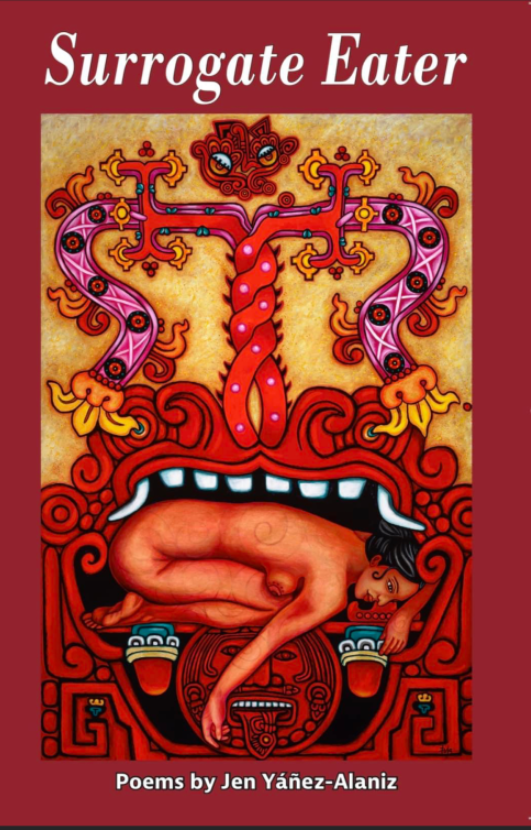
As compelling as the richly symbolic, saturated artwork that graces its front cover, Jen Yáñez-Alaniz’s admittedly slim (but no less emotionally packed) debut chapbook, Surrogate Eater, is one not to miss. Part-critique of the gendered roles expected of the speaker, part-reclamation of the speaker’s sexual identity, Yáñez-Alaniz’s chapbook is not so much a read but an embodiment of the sacred or, rather, what should be considered sacred and treated as such but is too often tragically not. Take, for example, the second verse paragraph of “Kneeling Quinceañera,” a poem in which the speaker implicitly questions the theological underpinnings of a traditional Latin American rite of passage for girls turning fifteen (and, thereby, presumably entering womanhood): “I am offered up in a white dress, / a vessel of transgression / and sex” (Yáñez-Alaniz 31). Take, for another example, the opening couplet of “Running (Invasive Memory),” in which the speaker acknowledges the harmful legacy of gendered cultural/religious norms and expectations: “I know of sin and shame, / the obligation of silence / in my body, / the red ribboning loom / of womanhood” (ibid. 23).
For every poetic acknowledgement of feeling or being shamed in Surrogate Eater, however, equally arresting lines or verse paragraphs of sexual reassertion and liberation ultimately attend. In “Kneeling Quinceañera,” for example, the speaker gestures with irreverence at the Virgin Mary, then applies traditionally religious imagery to apotheosize the bodily source of her sexuality: “I retch / an absolution, / knuckles clench / the base / of my altar” (ibid. 31). Likewise, in “Running (Invasive Memory),” the speaker not only repudiates the social expectation of female purity, as symbolized by the biblically erroneous characterization of the Mary Magdalene as a repentant prostitute (“I pray for the licentiousness / lust of Mary Magdalene”), but inverts the image of Adam’s ribs (the organ from which the biblical Eve is formed), identifying her own body as a creative locus of the sacred instead of a mere potential site of procreation: “My ribs [indent] my altar” (ibid. 23).
Whether working in couplets (as in the case of “To Be Born a Son”) or in verse paragraphs (as with “Patron Saint of Moist Things”), whether employing form (as in the case of “Sonnet for Hunger”) or utilizing free verse (as with “Binding”), Yáñez-Alaniz’s debut chapbook seemingly effortlessly traverses both time and place, drawing on both pre-Columbia language and imagery, as well as Catholic/Mexican-American traditions and practices. In “Grandmother, Yohl Ik’nal,” for example, a free-verse poem in which the speaker compares her late loved one to a Mayan queen, Yáñez-Alaniz blends pre-Columbian lineage with Texas’ signature geographical landscape (admittedly somewhat ironic, given the political history and realities of the state around migration and transnational borders). Though hardly the only piece within Surrogate Eater to do so, “Grandmother, Yohl Ik’nal” not only acknowledges and recognizes but honors the ways in which one’s recovery and invocation of an ancestral identity can help one process and evaluate the present, allowing them to imagine and unlock an otherwise unthinkable, but no less welcome, future.
To miss out on Yáñez-Alaniz’s debut chapbook is to withhold from yourself the embodiment of a sacred experience. Let Surrogate Eater show you what is truly profane, what is worthy of devotion, what is worthy of reclamation. Let such a literary revelation change you.
Yáñez-Alaniz’s debut chapbook expects no less, asks no less.
Originally from San Antonio, Texas, Jonathan Fletcher, a queer, disabled writer of color, holds a Master of Fine Arts in Creative Writing (Poetry) from Columbia University School of the Arts. His work has been published in The Adroit Journal, Arts Alive San Antonio, The BeZine, BigCityLit, Catch the Next: Journal of Ideas and Pedagogy, Colossus Press, Curio Cabinet, Door is a Jar, DoubleSpeak, Emerge Literary Journal, Flora Fiction, FlowerSong Press, and Half Hour to Kill.

 VAGABOND CITY