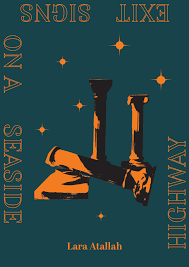
In Lara Atallah’s Exit Signs on a Seaside Hghway, poems bloom like stubborn flowers from a rubble of violence and heartbreak that is very much alive, presenting devastating paradoxes of love that knows its own futility and prevails anyway, and a hope that walks through fire, resisting annihilation, while never turning its back on the darkness. In these poems, Atallah not only bears witness to this violence and its aftermath, but introduces parallel universes in which the land is not ravaged by war and diaspora is the alternate reality. These parallel universes are neither fantastical nor uncomplicated. They are defined by the mundanity of daily life undisrupted by bombs or occupation: a thriving orchard, a day at the beach, none of which come without sacrifice. In the collection’s opening poem “Elsewhere,” Atallah writes: “A concave soil cradles you through heartbreak. The / same soil we turned into a mass grave in this universe. / My mother, perhaps happy. Me, perhaps never born.”
Atallah rejects the colonial abstraction of borders and forces the reader to confront the material reality of colonial violence, rooting the reader in a land that is bodily and tactile, inextricable from the bodies of its inhabitants who have become exiles. From “Parcelled Dunam,” “Land speaks through wildfires / the mother tongue of the indigenous. / The inventory of colonial violence is written with / the disconnected roads paved with bodies like sunflowers / searching for daylight. The disconnected roads / we trace on each other’s backs.” In this book, there is no separation between land and body – they are one and the same. They incur the same wounds, the same losses, and the body exiled from the land is exiled from itself, as Atallah writes in “Mother tongue,” “Language is a mother carrying you on her back / before time estranges you from yourself. / Shockwaves traverse me. My body / slowly arches back while the city / kneels to kiss the earth.”
In every poem in Exit Signs on a Seaside Hghway, life asserts itself. No easy answers exist in these poems, but in them, living is an act of defiance. The inhabitants of these poems get drunk and dance and make love. From “Postcard”: “What if / we were to meet at the start of time / and rewrite the world from scratch? / On my last day on Earth, I’ll spin / sunsets in your eyes and we’ll / grieve together the pastures we / never walked, the seas that never / touched our bodies before spitting / them out in the fire of an August Sun.” They live for themselves, for their ancestors, and while they never shy from the reality of a world whose bureaucracy is even violent, their imagined futures are imbued with the surreal beauty of love, a love as vast and renewing as the sea: from “Consider the firefly,” “You tell me to remember that / daylight anywhere is an / opportunity. That what you / nurture loves you back, / and the answers to most things / live in the creases of your darkness.”
All throughout Exit Signs on a Seaside Hghway, Atallah evokes an urgency born from an encompassing love for the world and its living, even as it lays bare the catastrophic truths of life under occupation in perpetual wartime. These poems paint a world that is dark and gory, bloody and scorched, yet dappled with light and moments of sweetness, a world worth living in, and a world worth saving.
Theo LeGro is a Vietnamese American poet who has received a Pushcart Prize nomination and fellowships from Kundiman. Their work appears or will appear in diode, Frontier, Raleigh Review, SARKA, and other journals. They live in Brooklyn with a cat named Vinny. Find them on Instagram at @theolegro.

 VAGABOND CITY