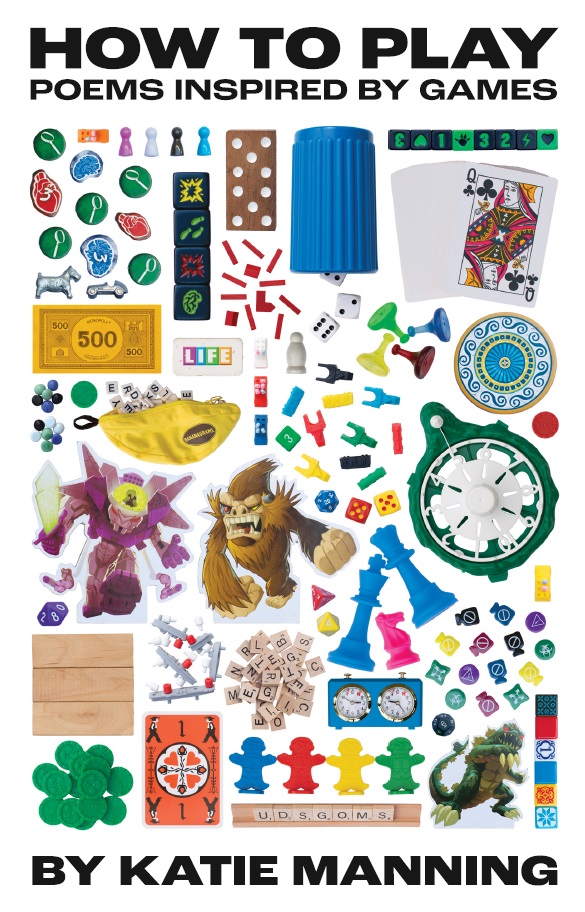
Katie Manning’s collection, How to Play: Poems Inspired By Games, opens the door to a fantastical world where Monopoly Scottie dogs, Candy Land children, and Scrabble titles come to life to reassure the reader of their experiences. In the ongoing political climate and struggle with the pandemic, nostalgia has become a comforting balm. Longing for the simpler, untroubled time of our youth, where our imagination and play ran wild, the events of the last few years have people reaching for these sentimental items for comfort. Look no further than the recent release of the 90s American Girl Doll.
In How to Play: Poems Inspired By Games, Katie Manning uses the seemingly carefree world of nostalgic games we love to open an exploration of serious topics such as the pandemic, mortality, and motherhood, among others. How to Play: Poems Inspired By Games offers a safe space for readers to confront their deepest fears. The innocence of these childhood games disarms the reader’s barriers, making these complicated topics less daunting and intimidating.
One of the most meaningful instances of using a game as a safe space is in the poem, “Post-Partum Jenga.” Manning writes:
I almost see myself trip and shatter
us both on the stairs. I almost see
my arms slip and tumble him over
the balcony to crack on the sidewalk
below (16).
Just as the blocks of Jenga come crashing down, so do the mother’s fear and anxieties. The inadvertent and sudden destruction of the game runs parallel to the mother’s concerns that a sudden accident will cause her and her child harm. Jenga as a metaphor goes beyond the stumbling blocks and creates palpable emotional upheaval. With the birth of her child, the mother’s abruptly restructured life feels changed at a moment’s notice, just as Jenga is unexpectedly restructured with each player’s turn. Whether becoming a new mother or dealing with the sudden turmoil of the pandemic, a reader can relate to the shifting landscape that they must navigate throughout their life.
Similar to Jenga’s sudden rearrangements, Manning traces another of life’s rearrangements: illness and medical uncertainty. Poems throughout the collection discuss cancer, COVID-19, and Alzheimer’s. In the poem, “Scrabble with E.B. White” Manning expresses:
Runt. Ax. Child.
Loving. Win. Web.
Our words were haunted.
I first read Charlotte’s Web
when I was nine, I said.
I still love it. Do you enjoy it too?
Yes, it’s a great story, he said,
brow furrowed. Would you remind me
who wrote it? (4).
As Charlotte rearranges the sinews of her web, the speaker of the poem rearranges the Scrabble tiles. Together, the web and Scrabble combine the adult experiences of life with the innocence of childhood games and stories. Like Scrabble, when the titles are arranged in the correct order words are formed. However, Manning illustrates how Alzheimer’s changes the patient’s brain, often shuffling and confusing linguistic abilities and language. The words shift their individual letters to become mixed-up like the tiles of a Scramble board.
Jumbled Scrabble tiles as an allusion to the linguistic difficulties Alzheimer’s produces is further explained in the “Notes” section of the collection. E.B. White’s dialogue is based on an NPR interview, which details White’s son reading his father’s work aloud, while White had Alzheimer’s. When White would ask who wrote it, his son would reply “You did, Dad” (22). White would reply “Not bad” (22). Together “Scrabble with E.B. White” and the Note section, explore that sadly both White and Charlotte must eventually bid farewell to language, communication, and writing.
Sadly many others, like White and Charlotte, bid farewell to language. The poem is a sobering reminder that almost everyone knows someone who is affected by Alzheimer’s. The Alzheimer’s Association reports, “6.7 million Americans are living with Alzheimer’s disease. By, 2050, this number is projected to rise to nearly 13 million.” This frightening statics proves, as the poem states, “our words were haunted.” As the board slowly stops filling up with titles, so does the brain slowly stop filling with words. The innocence of the game softens the harsh reality of illness and death to illustrate that on the next turn, even just for a moment, these rearranged titles have the potential for deep meaning and connection through language.
The metaphors these games create present the difficult rearranging and restructuring of life as not only tangible but as innocent as a child playing the game of Life. In many poetic works, the life-altering and weighty topics of illness, death, and the pandemic, among others, are often bent on destruction. Instead, in How to Play: Poems Inspired By Games, these topics are deconstructed and broken down into their game pieces, where the player still has the opportunity to change the outcome. While the collection discusses challenging topics and changes in life, the collection as a whole is a sanctuary. Keeping the innocence and fun of childhood games in mind, these intimidating and scary moments in life are not permanent but have the opportunity to change for the better with the player’s next turn. After all, when it comes to life’s unexpected changes, as Manning writes, “All you can do is roll the dice and hope […] (9).”
Sara Pisak is a reviewer, essayist, and poet. As a reviewer, Sara has a 1st place award from the Society of Professional Journalism. She has published work in The Rumpus, Hippocampus, the Deaf Poets Society, Door is a Jar, and Appalachian Journal, among others. In total, she has published over 100 pieces. When not writing, Sara can be found spending time with her family and friends.

 VAGABOND CITY